



A Net 30 invoice requires a client to pay the total outstanding balance within 30 calendar days of the invoice issuance date. While Net 30 is the gold standard in corporate enterprise accounting, it essentially turns a freelancer into an interest-free lender who finances their client’s operational expenses for an entire month after completing the work.
Understanding when to accept Net 30 terms and how to mitigate cash flow vulnerability is critical for independent contractors, creative consultants, and agency operators. Failing to protect your payment terms can trap your business in working capital deficits, delayed personal payroll, and painful collections cycles.
How Net 30 Invoicing Operates in Practice
Under Net 30 terms, the 30-day countdown begins on the invoice generation date, not on project completion or delivery sign-off. If you submit an invoice on October 1st, the payment deadline matures on October 31st, regardless of weekends or commercial bank holidays.
Enterprise accounts payable (AP) departments rely on Net 30 to align disbursements with internal weekly or bi-weekly check and ACH payment runs. Large corporations process thousands of vendor invoices through multi-layered managerial approvals, making instant payments administratively impossible under standard corporate bylaws.
Calendar Days vs. Business Days
Unless your contract explicitly specifies “30 Business Days”, commercial statutory standards treat Net 30 as 30 consecutive calendar days. If the 30th day falls on a Saturday, Sunday, or federal banking holiday, the maturity date automatically shifts to the immediate following business day.
The Strategic Pros and Hidden Cons for Freelancers
Accepting Net 30 unlocks high-value enterprise contracts, but it simultaneously exposes solo operators to severe liquidity bottlenecks. Freelancers must weigh corporate marketability against operational risk before agreeing to these terms.
| Advantages (The Pros) | Disadvantages (The Cons) |
|---|---|
| Enterprise Vendor Eligibility: Fortune 500 corporations and established tech firms mandate standard net terms. Agreeing to Net 30 allows you to bid on and win large-budget multi-thousand dollar contracts. | Cash Flow Starvation: Working for 30 days and then waiting another 30 days creates an effective 60-day cash gap between labor expenditure and cash realization. |
| Competitive Commercial B2B Image: Adopting standard trade credit structures signals that your freelance practice operates as an organized, mature professional business entity. | Compounded Late Payment Risks: Corporate accounts frequently delay payment past the 30-day mark, pushing actual settlement to Day 45 or Day 60 without immediate warning. |
| Long-Term Client Trust & Goodwill: Corporate procurement leads appreciate vendors who seamlessly integrate into their standard accounts payable cycles without demanding custom handling. | Unfunded Operational Overhead: Freelancers must cover software subscriptions, contractor sub-costs, taxes, and living expenses out of savings while waiting for client settlement. |
Net 30 vs. Alternative Payment Terms: Comparative Breakdown
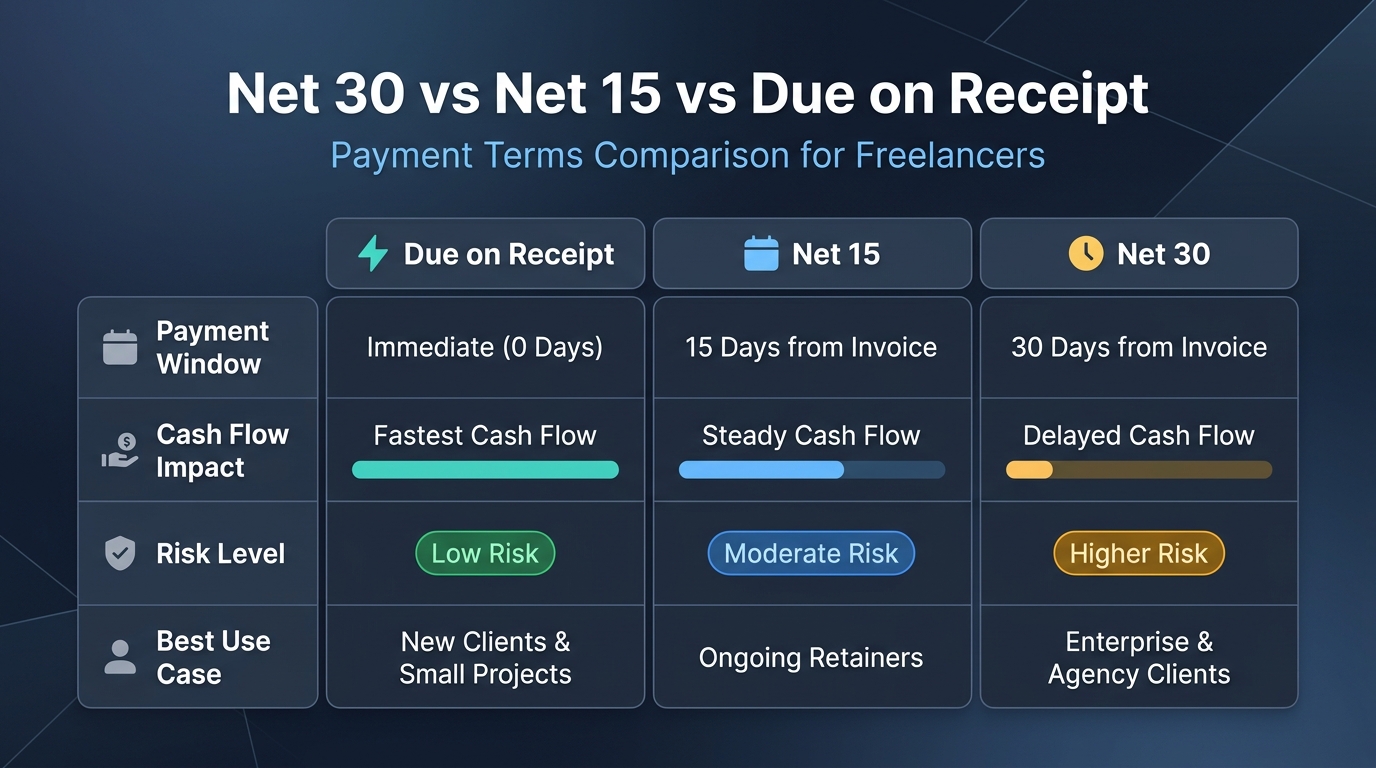
Freelancers should reserve Net 30 exclusively for vetted corporate entities while deploying shorter terms for standard clients. Aligning terms with client risk profiles protects working capital.
| Invoice Term | Settlement Window | Cash Flow Impact | Best Freelance Scenario |
|---|---|---|---|
| Due on Receipt | Immediate (0–48 Hours) | Maximum Liquidity | New clients, small one-off projects, emergency work |
| Net 7 / Net 10 | 7 to 10 Calendar Days | Rapid Recovery | Weekly retainers, hourly billing, small businesses |
| Net 15 | 15 Calendar Days | Balanced Runway | Mid-sized businesses, ongoing monthly advisory contracts |
| 2/10 Net 30 | 10 Days (Discounted) / 30 Days | Incentivized Cash Flow | Enterprises with strict Net 30 policies |
| Net 30 | 30 Calendar Days | Extended Delay | Enterprise brands, government agencies, corporate retainers |
When dealing with extended payment cycles, pair your billing strategy with an automated tracking and recovery process. If an enterprise client exceeds the 30-day window, immediately deploy our step-by-step framework on how to write a polite payment reminder email for overdue invoices to secure disbursement without causing friction.
How Freelancers Can Safely Negotiate and Protect Net 30 Invoices
Never accept Net 30 passively without inserting protective contractual guardrails. Professional freelancers deploy four legal and operational safeguards before executing a contract containing 30-day terms.
- Mandate Upfront Deposits (50/50 Billing): Require a 30% to 50% non-refundable deposit before initiating work, applying Net 30 terms solely to the final milestone payment. This guarantees your immediate operating expenses are covered regardless of downstream accounts payable delays.
- Offer a Early Payment Cash Discount (2/10 Net 30): Offer a 2% discount if the client remits payment within 10 days. Corporate treasuries frequently jump at 2% discounts because annualized savings beat institutional money-market yields.
- Incorporate Statutory Late Interest Clauses: Clearly stipulate in your Master Services Agreement (MSA) that balances past 30 days incur a monthly interest surcharge (typically 1.5% per month or 18% APR, subject to local usury laws).
- Trigger Automatic Service Suspensions: State explicitly that ongoing retainer support, software code handovers, or commercial usage licenses remain conditional upon prompt invoice settlement. If day 31 passes unpaid, active production stops.
For independent contractors managing larger commercial operations, establishing systematic tracking pipelines is essential. Review our guide on tracking unpaid invoices for small businesses to configure automated notifications and prevent aging balances from undermining solvency.
Essential Checklist: What to Include on a Net 30 Invoice
Ambiguity on an invoice gives corporate accounts payable teams an easy excuse to reject or delay payment. Every Net 30 freelance invoice must present these six items clearly:
- Invoice Date and Explicit Due Date: State both the generation date and the exact maturity date (e.g., “Invoice Date: October 1, 2026 | Payment Due: October 31, 2026”). Avoid writing simply “Net 30” without a specific calendar date.
- Client Purchase Order (PO) Number: Enter the client’s internal purchase order or approval code prominently at the top of the header. Corporate AP software automatically rejects invoices lacking an approved PO match.
- Itemized Scope and Deliverables: Break down service lines, hours worked, or milestone deliverables with crisp, professional descriptions.
- Applicable Tax and ID Information: Provide your W-9/W-8BEN details, Employer Identification Number (EIN), or Tax ID to prevent withholding holds.
- Multiple Electronic Payment Rails: Include direct ACH routing and account numbers, wire codes (SWIFT/BIC for cross-border transactions), and secure online credit card payment links.
- Overdue Terms Notice: Add a standard footnote: “Terms: Net 30. Accounts past due are subject to a 1.5% monthly finance charge.”
Frequently Asked Questions
-
Does Net 30 mean 30 calendar days or 30 business days?
Net 30 means 30 consecutive calendar days from the invoice issuance date, including weekends and holidays. If an invoice is issued on March 1st, full payment is due on March 31st. Payment defaults to the next business day only if the 30th day falls on a weekend or federal banking holiday.
-
Should freelancers accept Net 30 terms from new clients?
Freelancers should avoid offering Net 30 to brand-new, unvetted clients or small businesses. New clients should pay either a 50% upfront deposit with the balance due on receipt, or operate on Net 7 to Net 15 terms until they demonstrate a reliable, multi-month payment track record.
-
What does 2/10 Net 30 mean for a freelance invoice?
The term 2/10 Net 30 means the client receives a 2% discount if they settle the bill within 10 days, while the full balance remains due in 30 days. This trade credit incentive encourages enterprise accounts payable departments to disburse funds weeks ahead of the standard 30-day window.
-
What should a freelancer do if a Net 30 invoice is not paid on day 31?
Send a polite payment reminder email with the invoice attached on Day 31, followed by a direct phone call to your project champion if payment is unconfirmed by Day 35. If the delay exceeds 45 days, halt all active project deliverables and issue a formal late fee adjustment notice.

