



A polite payment reminder email secures payment within 48 to 72 hours by maintaining a cooperative tone while clearly restating the invoice number, outstanding balance, original due date, and direct payment link. Invoicing delays often stem from administrative bottlenecks, missed approvals, or inbox clutter rather than deliberate evasion. Framing your initial outreach around administrative clarity preserves client goodwill while establishing firm boundaries around cash flow collection.
When an invoice passes its maturity date, aggressive demands risk alienating dependable clients and delaying resolution. Conversely, waiting passively damages your working capital and increases default risks over time. Establishing an automated, tiered escalation cadence ensures consistent cash flow recovery without sacrificing relationship equity.
The 4 Essential Components Every Payment Reminder Must Contain
Every effective payment reminder email must present four key data points in the initial three lines of text. Missing details force accounting personnel to search internal archives, directly postponing payment runs to the subsequent weekly or bi-weekly cycle.
Ensure every reminder contains these four elements before transmission:
- Specific Invoice Number and Project Reference: State the exact identifier (e.g.,
INV-2026-084) alongside the specific milestone or project scope in both the subject line and body text. - Exact Outstanding Amount and Currency: Clarify the precise balance due, including any applicable currency designations (e.g., USD, EUR, GBP) and itemized late interest where contractually applicable.
- Original Due Date and Days Overdue: Reference the contractual maturity date and specify the current elapsed timeline (e.g., “7 days past due”) to establish operational urgency.
- Direct, Frictionless Payment Methods: Provide active one-click ACH links, wire transfer routing instructions, credit card portal URLs, or merchant gateways directly in the message.
Always attach the original invoice PDF and relevant timesheets or receipts directly to every email. Providing immediate documentation eliminates the standard friction response: “Could you re-send the invoice copy?”
Strategic Email Cadence: When to Send Each Reminder
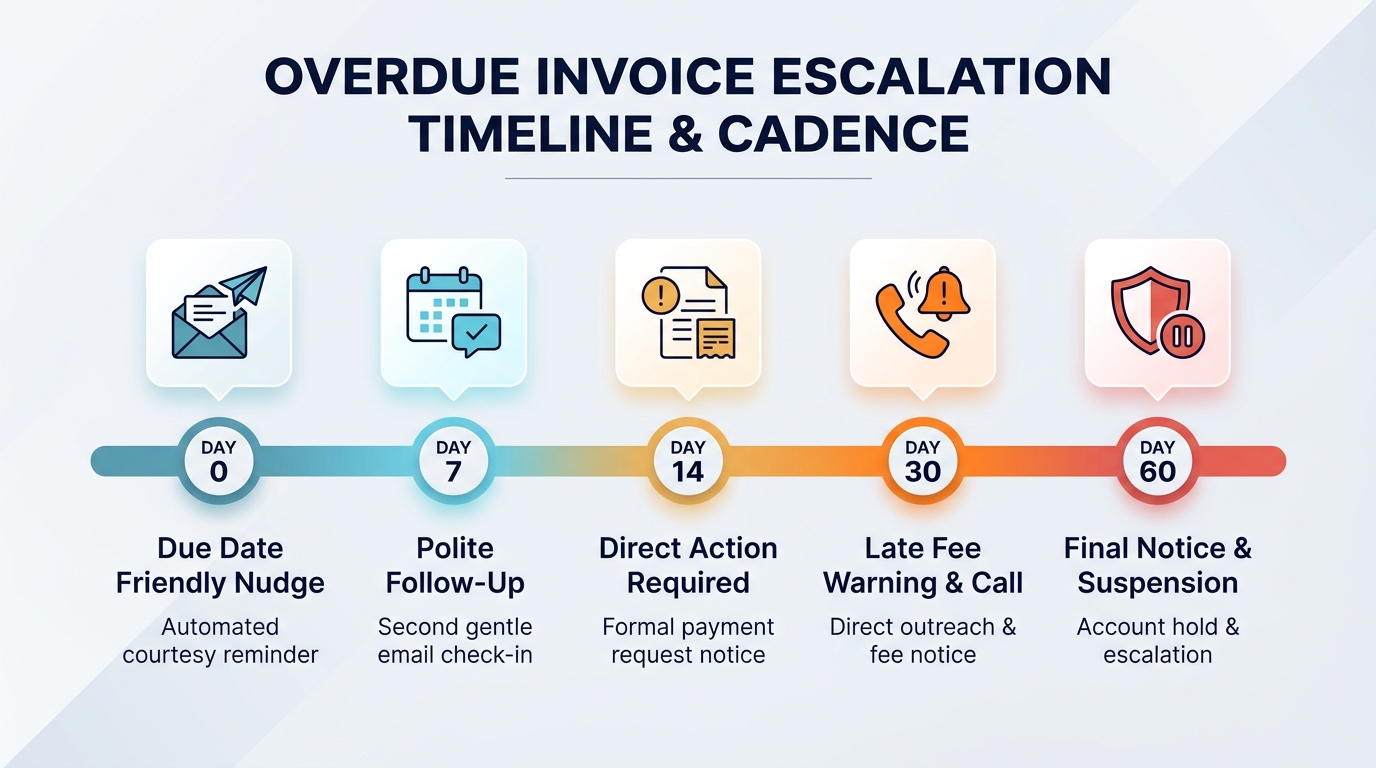
A disciplined payment follow-up cadence balances professional courtesy with systematic escalation across standard 7-, 14-, 30-, and 60-day recovery intervals. Staggering communication ensures accounting teams receive sufficient processing runway before leadership steps in.
| Cadence Window | Primary Tone | Core Objective | Recommended Action |
|---|---|---|---|
| Day of Due Date | Friendly Courtesy | Top-of-mind confirmation | Automated email nudge with PDF attached |
| 7 Days Overdue | Helpful & Direct | Check receipt and processing status | Personalized follow-up to billing contact |
| 14 Days Overdue | Firm & Formal | Confirm explicit disbursement date | Email + CC Project Manager / Sponsor |
| 30 Days Overdue | Urgent & Contractual | Notice of late fees & work pause | Direct phone call + formal written warning |
| 60+ Days Overdue | Final Demand | Pre-legal / Collections notice | Formal legal demand letter & service freeze |
For small businesses tracking receivables across diverse client tiers, pairing these emails with an established internal pipeline is vital. Consult our comprehensive guide on how to track unpaid invoices for small businesses to establish automated recovery protocols across your accounting stack.
5 Polite Payment Reminder Email Templates (Copy and Paste)
Deploying battle-tested templates prevents emotional overreactions and standardizes your accounts receivable workflow. Below are five ready-to-use scripts tailored for every escalation stage.
Template 1: Friendly Due Date Reminder (Day 0)
Goal: Provide a non-intrusive reminder on the actual due date to ensure processing in the current banking batch.
Hi [Client First Name],
I hope you are having a productive week.
This is a quick courtesy note to remind you that Invoice #[Invoice Number] for $[Amount Due] for [Project/Service Name] is due today, [Due Date].
I have attached a copy of the original invoice for your records. You can remit payment directly via our secure portal here: [Direct Payment Link], or via the wire/ACH instructions detailed on the invoice.
If you have already initiated this transfer, please disregard this note. Thank you for your continued partnership!
Best regards,
[Your Name]
[Your Title]
[Your Company Name]
Template 2: Polite 7-Day Follow-Up (One Week Overdue)
Goal: Inquire gently about whether any administrative barriers or missing paperwork caused the delay.
Hi [Client First Name],
I hope you are doing well.
Our accounts team noted that we haven’t yet received payment for Invoice #[Invoice Number] ($[Amount Due]), which reached its maturity date on [Due Date].
We understand that billing details occasionally get tied up in departmental approvals. Could you please confirm if you received the initial invoice, or if you need any additional PO numbers or documentation from our side to process it?
For your convenience, I have re-attached the invoice PDF here: [Direct Payment Link].
Thank you for looking into this, and please let me know when we can expect disbursement.
Best regards,
[Your Name]
[Your Company Name]
Template 3: Direct Action Required (14 Days Overdue)
Goal: Shift from casual inquiry to an explicit request for a firm disbursement schedule while looping in key stakeholders.
Hi [Client First Name],
I am writing regarding Invoice #[Invoice Number] for $[Amount Due], which was due on [Due Date] and is now two weeks overdue.
Despite our previous notes, we have not received payment or an estimated remittance date. As a reminder, timely settlements ensure we can maintain scheduled project deliverables and resources without interruption.
Please review the attached PDF and confirm when this payment will be scheduled. You can settle the balance immediately via our direct payment portal: [Direct Payment Link].
If you are experiencing unexpected processing delays, please reply directly so we can work together on a workable resolution.
Sincerely,
[Your Name]
[Your Title]
Template 4: Late Fee Warning & Work Stoppage Notice (30 Days Overdue)
Goal: Enforce contractual late interest terms and clearly signal operational consequences if the balance remains unpaid.
Dear [Client First Name],
Our records indicate that Invoice #[Invoice Number] for the original balance of $[Original Amount] is now 30 days past due (original maturity date: [Due Date]).
Per Section [X] of our signed service agreement, overdue accounts past 30 days accrue a late fee of [1.5% / $X per month]. An updated invoice reflecting the current adjusted balance of $[Total Amount with Late Fee] is attached.
To avoid an automatic pause on active deliverables and support services, please arrange full settlement by [Date – 5 Business Days Out]. Payment can be processed immediately via [Direct Payment Link] or direct bank transfer.
Please treat this matter with immediate priority and confirm your transfer details upon completion.
Regards,
[Your Name]
[Your Title] / Finance Department
Template 5: Final Demand Notice Before Collections (60 Days Overdue)
Goal: Present an unmistakable final ultimatum before transferring the debt to third-party recovery or initiating formal litigation.
Dear [Client First Name / Company Management],
This is our final formal notice regarding outstanding Invoice #[Invoice Number] for $[Total Amount Due], which is now 60 days overdue despite multiple notifications.
All active project milestones and account services remain suspended. Unless full payment is remitted by [Firm Date – e.g., 5:00 PM EST, Friday, Month Day, Year], we will escalate this account to our legal counsel and an external debt recovery agency.
To prevent legal action, damaged credit reporting, and additional legal fee liabilities, submit payment immediately using this link: [Direct Payment Link], or wire funds directly using the banking details on the attached invoice.
Please send proof of transfer immediately upon execution.
Sincerely,
[Your Name]
[Your Company Name] / Executive Office
How to Legally and Professionally Implement Late Fees
Contractual late fees function as compliance incentives rather than revenue streams, but they require strict prior disclosure to remain legally enforceable. You cannot retroactively introduce interest penalties if your initial statement of work (SOW) or master services agreement (MSA) did not define them.
When implementing late fee policies, adhere to these three core standards:
- Upfront Written Disclosure: Ensure the client explicitly signs payment terms stating the exact monthly interest rate (typically 1.5% per month or 18% APR) and the exact grace period (usually 30 days) before work begins.
- Statutory Usury Rate Compliance: Check state and regional statutory interest ceilings. Exceeding local usury caps can void your late fee provisions and subject your business to regulatory penalties.
- Consistent Grace Period Applications: Grant a standard 5-to-10 day administrative grace window before levying fees. Offering to waive the initial fee upon immediate payment often yields immediate cash recovery.
The 4 Common Traps That Delay Invoice Settlements
Most collection delays are caused by vendor-side communication mistakes rather than intentional client non-payment. Eliminating these four behavioral traps dramatically shortens your Days Sales Outstanding (DSO).
- The Apology Trap: Never start a reminder with “Sorry to bother you” or “I apologize for asking.” Reminding a client of a contractual debt is a standard administrative duty, not an imposition.
- The Single Recipient Bottleneck: Sending invoices exclusively to your primary project contact often stalls payment when they fail to forward it to accounts payable. Always CC the accounting department directly.
- Vague Deadlines: Phrases like “at your earliest convenience” create zero operational urgency. Always state hard deadlines, such as “by Friday, March 14, at 5:00 PM EST.”
- Absence of Direct Payment Rails: Requiring clients to print, sign, and mail physical checks adds 10 to 14 days of avoidable latency. Provide immediate electronic ACH and card payment links.
Frequently Asked Questions
-
When is the best time of day to send a payment reminder email?
Tuesday and Thursday mornings between 8:30 AM and 10:00 AM in the recipient’s local time zone yield the highest response rates. Sending reminders during early morning hours ensures your email sits near the top of the accounting manager’s queue before scheduled daily batch payments run.
-
How many payment reminder emails should you send before calling?
You should initiate a direct phone call after sending two unanswered emails, typically at the 14-day overdue mark. A polite phone call to the accounting coordinator clarifies whether the hold-up is technical or cash-flow related much faster than repeated emails.
-
Can you charge late fees if they were not in the original contract?
No, you cannot legally impose late fees or interest charges unless the client agreed to those specific terms in a signed agreement or accepted quote prior to service delivery. Adding unexpected penalties to subsequent invoices damages trust and is legally unenforceable in most jurisdictions.
-
What should you do if a client completely ignores payment reminder emails?
If emails and phone calls go unanswered past 30 days, pause all active deliverables, issue a formal demand letter via certified mail, and notify company executives. If non-responsiveness persists beyond 60 days, transition the balance to a reputable collections agency or initiate small claims court proceedings.

