



A standard SWIFT international wire transfer from Europe to the United States takes between 1 and 3 business days on average, while modern SWIFT gpi (Global Payments Innovation) transfers frequently settle within 30 minutes to 24 hours. Because the transatlantic banking corridor links major financial clearing hubs, over 70% of gpi-tracked payments are credited to US beneficiary accounts on the same business day. However, non-standard processing—caused by missed daily bank cutoff times, multiple correspondent intermediary hops, weekend banking shutdowns, or automated AML compliance holds—can stretch total transit time to 4 or 5 business days.
Understanding the exact mechanics of international interbank messaging enables corporate treasurers, importers, and individuals to avoid friction. Below is the definitive operational breakdown of Europe-to-USA SWIFT transit timelines, cut-off mechanics, correspondent routing, and strategies to track funds in real time.
Quick Transit Timeline Summary
- SWIFT gpi Tier-1 Corridor: 30 minutes to 24 hours (Over 70% settle same-day).
- Standard International SWIFT: 1 to 3 business days (Typical for regional EU and US banks).
- Transfers with Weekend/Holiday Overlap: 3 to 5 calendar days (SWIFT network halts on bank holidays).
- Compliance Review (OFAC / AML Hold): 3 to 7+ business days (Requires manual documentation).
How Modern SWIFT gpi Accelerated Transatlantic Wires
Historically, international wire transfers traveled through a fragmented web of correspondent banks without centralized oversight. A transaction initiated in Frankfurt or Paris frequently took 4 to 6 business days to reach a regional bank in Ohio, with neither sender nor receiver able to identify where funds were held.
The introduction of SWIFT gpi (Global Payments Innovation) revolutionized cross-border liquidity across the Europe-to-North-America corridor. By mandating strict Service Level Agreements (SLAs) across participating institutions, SWIFT gpi enforces end-to-end tracking using a unique 36-character UETR (Unique End-to-End Transaction Reference) code. Today, if both your European originating bank (e.g., BNP Paribas, Deutsche Bank, Barclays) and the US receiving institution (e.g., JPMorgan Chase, Bank of America, Citibank) operate on the gpi framework, funds settle within hours with transparent fee reporting.
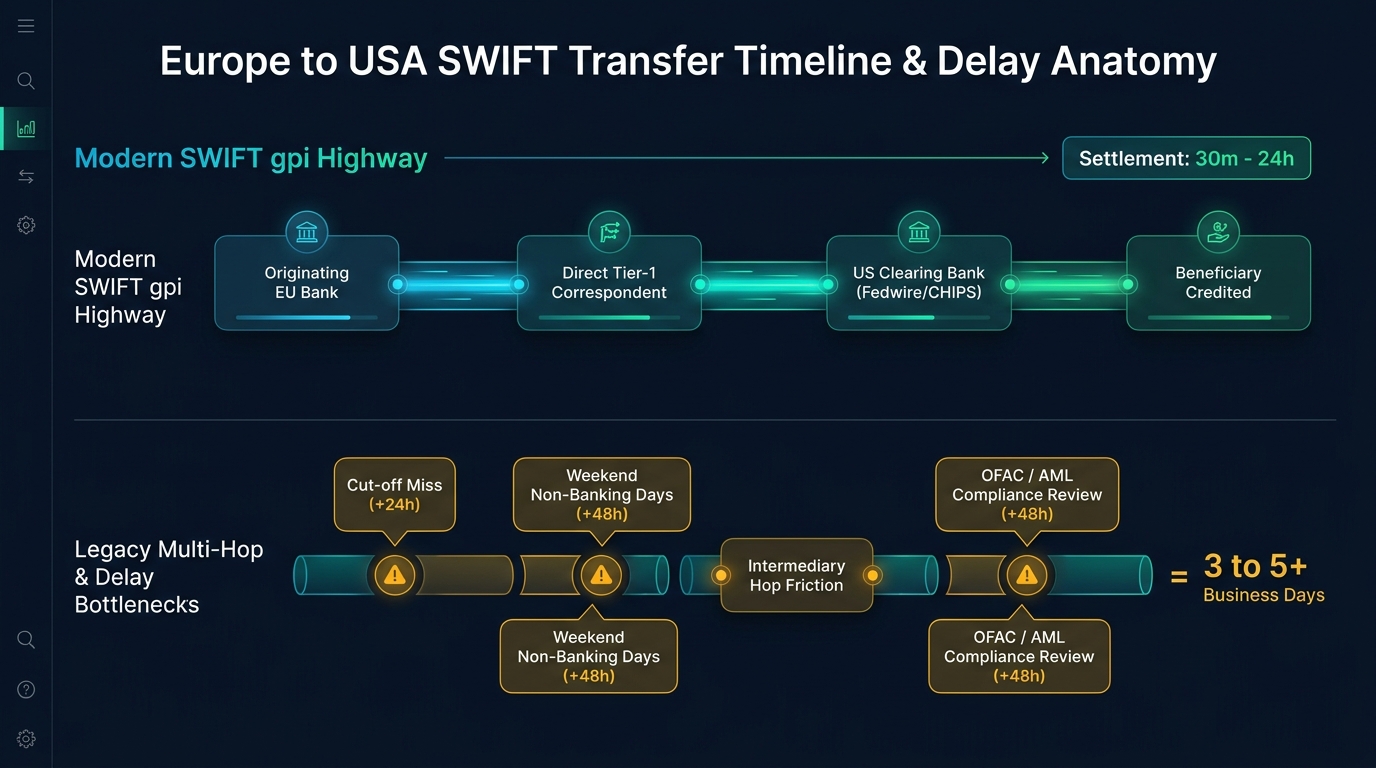
Figure 1: End-to-end Europe-to-USA SWIFT settlement velocity: gpi direct highway vs. multi-hop delay traps.
The 4 Key Factors Dictating Europe-to-USA Transfer Duration
While electronic messages transmit in milliseconds, financial settlement relies on banking operational windows. Four primary variables determine your delivery timeline:
1. Transatlantic Time Zones & Daily Cut-Off Times
Every commercial bank enforces a strict daily wire processing cutoff time, typically between 2:00 PM and 4:30 PM local time. Europe sits 5 to 9 hours ahead of the United States. If a sender in London or Berlin submits an international wire at 5:30 PM CET, the European bank will not queue the instruction until the following business morning.
Furthermore, initiating a transfer on Friday afternoon triggers the “weekend trap.” Because central banking clearing systems (including the Federal Reserve Fedwire service and European TARGET2) close over weekends, wires submitted late Friday remain dormant until Monday morning, adding 72 hours of dead time.
2. The Intermediary (Correspondent) Banking Chain
Unless both institutions share a direct bilateral ledger account, funds must route through correspondent intermediary banks. If a mid-sized German cooperative bank transfers USD to an American regional credit union, the payment routes through a major New York clearing institution (such as BNY Mellon or Citi).
Each intermediary bank in the chain must parse the SWIFT MT103 or modern ISO 20022 message, verify ledger balances, and forward the balance. While direct routes complete in 2 hours, multi-hop chains involving two or three intermediaries introduce 24 to 48 hours of transit lag.
3. Currency Conversion Mechanics (EUR vs. USD Settlement)
Transmitting funds in Euros that must be converted to US Dollars introduces foreign exchange validation cycles. If the sending European bank transmits raw EUR to an American bank that only maintains domestic USD accounts, the receiving bank’s treasury desk must manually route the wire through their foreign exchange clearing desk.
To maximize speed, instruct the European sender to wire the payment already denominated in US Dollars (USD). This allows the incoming wire to credit directly to the American account via standard domestic Fedwire clearing without conversion holds.
4. AML, OFAC, & Sanctions Compliance Screening
Every international dollar-denominated wire passing into the United States is subjected to automated screening by the US Treasury’s Office of Foreign Assets Control (OFAC) and FinCEN algorithms. Automated systems scan the beneficiary name, address, and remittance reference text against global sanctions lists.
If a sender inputs vague remittance notes (e.g., “urgent consulting payment” or names resembling sanctioned entities), the transaction is routed into a manual compliance queue. Resolving an OFAC or Anti-Money Laundering (AML) documentation request typically adds 2 to 5 business days to total settlement time.
Transit Time Comparison by Corridor & Institution Tier
The matrix below outlines expected transit horizons across various transatlantic transaction scenarios:
| Routing Scenario | Typical Transit Time | Primary Delay Risk |
|---|---|---|
| Tier-1 EU Bank to Tier-1 US Bank (SWIFT gpi) | 30 Minutes – 4 Hours | Afternoon cutoff time misses |
| Regional European Bank to US Commercial Bank | 1 to 2 Business Days | Single intermediary routing hop |
| EU Transfer Sent Late Friday Afternoon | 3 to 4 Calendar Days | Weekend interbank clearing closure |
| Transfer Flagged for OFAC/AML Review | 3 to 7+ Business Days | Manual proof of funds / invoice audit |
How to Accelerate Your Europe-to-USA Transfer
To guarantee fastest possible settlement and eliminate administrative holds, implement these four treasury protocols:
- Submit Before 11:00 AM CET: Submitting early in the European morning ensures your wire clears local verification and hits New York clearing houses before midday US trading hours.
- Request the 36-Digit UETR Code: Always ask the sending bank for the SWIFT gpi UETR tracking code immediately upon execution. This allows your US bank’s wire desk to trace the exact location of the wire in real time.
- Provide Precise Interbank Details: Never provide only an IBAN. For US credit, supply the exact 9-digit ABA Fedwire Routing Number, recipient account number, full legal corporate name, and physical address.
- Use Specific Remittance Descriptions: Avoid vague references like “funds” or “contract.” Use clean commercial identifiers such as “Commercial Invoice INV-2026-088 Consulting Services” to bypass automated sanctions filters.
For businesses seeking broader payment optimization, reviewing our analysis on ACH vs Wire Transfer vs RTP speed benchmarks and our comprehensive guide to reducing electronic payment transaction costs provides vital cross-border capital management strategies.
Frequently Asked Questions (FAQ)
-
Can a SWIFT transfer from Europe to the USA arrive on the same day?
Yes, SWIFT transfers between tier-1 European and US banks frequently arrive on the same business day. Under the modern SWIFT gpi framework, more than 70% of transatlantic transfers settle within 30 minutes to 4 hours, provided the wire is initiated before the European bank’s midday cut-off time.
-
Do SWIFT international transfers move over weekends?
No, traditional SWIFT wire transfers do not process over weekends or federal holidays. While electronic messaging networks operate continuously, the interbank clearing networks (such as Fedwire and TARGET2) remain closed, halting settlement until Monday morning.
-
Why is my SWIFT transfer from Europe taking longer than 3 days?
Transfers exceeding 3 business days are typically delayed by intermediary routing hops, mismatched banking details, or an AML/OFAC compliance review. In addition, missing daily cut-off times right before a weekend can add 72 hours of calendar delay without indicating a transaction error.
-
How do I track an incoming Europe-to-USA SWIFT transfer?
You can track a transatlantic transfer in real time by requesting the 36-digit UETR (Unique End-to-End Transaction Reference) number from the sender. Your US receiving bank’s wire department can input this UETR into the SWIFT gpi tracker to pinpoint the exact intermediary bank currently holding the funds.

