



Real-Time Payments (RTP) is the fastest payment rail for payroll, settling and making funds immediately available in employee bank accounts within 2 to 5 seconds, 24/7/365. In contrast, domestic Wire Transfers take between 2 and 4 hours to clear and operate exclusively during banking business hours. Automated Clearing House (ACH) transfers process in batches, requiring 1 to 3 business days for Standard ACH and 4 to 6 hours for Same-Day ACH under strict submission cutoff windows.
While RTP offers undisputed velocity, Standard ACH remains the cost-effective industry standard for recurring, scheduled payroll due to its near-zero per-transaction overhead ($0.05 to $0.30 per employee). Wire transfers are economically unfeasible for regular payroll distribution ($15 to $35+ per transaction), while RTP and FedNow deliver immediate liquidity for on-demand pay, off-cycle bonuses, and emergency termination checks. Below is the operational treasury breakdown of ACH, Wire Transfers, and RTP for payroll management.
The Executive Speed & Utility Verdict
- Fastest Overall: RTP / FedNow — 2 to 5 Seconds (Settles 24/7/365 including nights, weekends, and federal holidays).
- Fastest for High-Value Exceptions: Domestic Wire — 2 to 4 Hours (Business days only; high $15–$35 fees).
- Most Cost-Effective for Bulk Payroll: Standard ACH — 1 to 3 Business Days (Negligible cost; perfect for bi-weekly cycles).
- Best Balance for Emergency Runs: Same-Day ACH — Same business day (4–6 hours; modest $0.50–$1.50 per-item fee).
Direct Rails Comparison: ACH vs Wire Transfer vs RTP
Each banking rail was engineered for distinct commercial objectives. Comparing settlement mechanics, operating windows, and cost profiles demonstrates where each belongs in your payroll architecture.
| Feature / Rail | Standard / Same-Day ACH | Domestic Wire Transfer | RTP & FedNow Network |
|---|---|---|---|
| Settlement Velocity | 1–3 Days (Standard) / 4–6 Hours (Same-Day) | 2 to 4 Hours (Gross settlement) | Instant (2 to 5 Seconds) |
| Operating Hours | Business days only (Strict cutoffs) | Mon–Fri (8 AM – 5 PM EST) | 24/7/365 (Nights, Weekends & Holidays) |
| Cost per Transaction | $0.05 – $0.30 (Standard) / $0.50 – $1.50 (Same-Day) | $15.00 – $35.00+ per payout | $0.25 – $1.50 per payout |
| Payment Reversibility | Reversible via Nacha dispute rules (5 days) | Irrevocable upon Fedwire confirmation | Final and irrevocable instantly |
| Best Payroll Use Case | Standard scheduled bi-weekly salaried payroll | Executive exit settlements ($100k+) | On-demand pay, gig workers, off-cycle corrections |
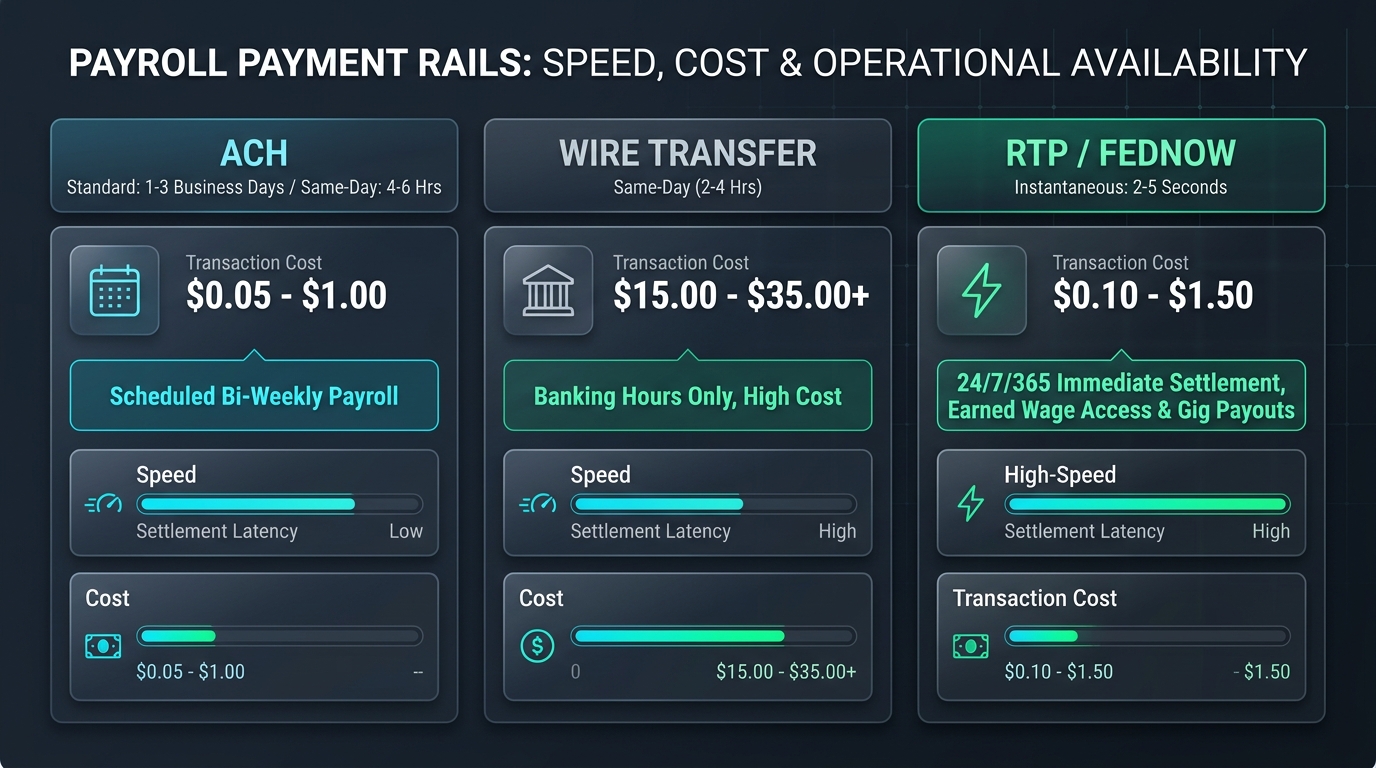
Figure 1: Comprehensive velocity, operating hours, and cost analysis across US payroll payment rails.
1. Real-Time Payments (RTP & FedNow): The Speed Benchmark
Developed by The Clearing House, the RTP network is the fastest payment rail operating in the United States today. Operating concurrently with the Federal Reserve’s FedNow service, RTP processes push-only credit transfers directly between commercial bank accounts within seconds.
For human resources and treasury teams, RTP completely removes banking calendar dependencies. If payroll requires approval at 11:30 PM on Sunday night, funds clear immediately into employee checking accounts before midnight. This makes RTP the ultimate operational tool for:
- Earned Wage Access (EWA): Allowing daily-wage or hourly shift workers to draw earned pay instantly at the end of their shift.
- Contractor & Gig Distributions: Delivering instant liquidity for freelance, delivery, or marketplace workers without multi-day settlement friction.
- Statutory Termination Payouts: Satisfying strict state labor laws (e.g., California Labor Code § 201) mandating immediate final wage disbursement upon discharge.
2. Wire Transfers: High Speed at Unsustainable Overhead
Wire transfers via Fedwire deliver near-real-time gross settlement but fail basic payroll cost-efficiency tests. Originating through direct interbank telegraphic messaging, domestic wires clear within 2 to 4 hours on standard business days.
However, commercial banks charge between $15 and $35 for every outgoing wire transfer, and receiving institutions frequently assess $10 to $20 incoming wire fees. Disbursing a 100-employee payroll run via wire transfers would cost your enterprise $2,500 in transactional friction per cycle ($65,000 annually). Furthermore, wire transfers shut down at 5:00 PM EST and remain dark throughout weekends and banking holidays, rendering them inferior to RTP in both speed and availability.
3. ACH (Standard & Same-Day): The Bulk Cost Champion
Automated Clearing House (ACH) direct deposit remains the foundational backbone of corporate payroll across the United States. Governed by Nacha, ACH functions as a net-batch processing clearinghouse where transactions are grouped and cleared in scheduled cycles.
Because ACH settles thousands of transactions simultaneously, processing costs drop to pennies ($0.05 to $0.30 per payment). Standard ACH requires a 2-day lead time: employers submit payroll files on Wednesday morning for Friday distribution. For off-cycle payroll runs or missed filing cutoffs, Same-Day ACH provides three daily clearing windows with settlement completed within 4 to 6 hours at a fraction of the cost of a wire ($0.50 to $1.50 per item).
How to Select the Right Rail for Your Payroll Strategy
Modern enterprise payroll architectures increasingly deploy a hybrid routing strategy rather than relying on a single channel:
- Primary Bi-Weekly Salaried Direct Deposit: Standard ACH. Maximizes float management and minimizes operating overhead.
- Urgent Friday Payroll Misses: Same-Day ACH. Inexpensive same-day recovery for delayed timecard approvals submitted before Nacha cutoff windows.
- Hourly Gig, Daily Pay, & Weekend Distributions: RTP / FedNow. Delivers sub-second employee satisfaction and competitive talent recruitment.
- High-Value Severance or Legal Executive Settlements: Wire Transfer. High-value transactions ($100k+) requiring instantaneous irreversible finality.
For finance departments managing working capital, reviewing our guides on tracking enterprise receivables and reducing electronic payment transaction fees provides essential cash flow preservation strategies.
Frequently Asked Questions (FAQ)
-
Which payment method is fastest for payroll?
RTP (Real-Time Payments) and FedNow are the fastest methods for payroll, settling instantly within 2 to 5 seconds. They operate 24 hours a day, 7 days a week, 365 days a year, allowing immediate employee funds access even on weekends and federal holidays.
-
Why don’t companies use wire transfers for regular payroll?
Companies avoid wire transfers for regular payroll because they cost $15 to $35+ per transaction. For a business with 50 employees, paying via wire would cost up to $1,750 per pay cycle in bank fees alone, compared to less than $15 using Standard ACH.
-
Can an RTP payroll payment be reversed if an error occurs?
No, RTP payments are final and irrevocable once confirmed. Unlike ACH transfers, which allow clawbacks or returns under strict Nacha rules within 5 business days, an erroneous RTP transfer requires requesting a voluntary refund from the recipient.
-
What is the difference between Same-Day ACH and RTP?
Same-Day ACH settles in batches within 4 to 6 hours on business days, whereas RTP settles in 2 to 5 seconds 24/7/365. Same-Day ACH is governed by Nacha and depends on daily bank clearing windows, while RTP operates continuously around the clock.

