
The realistic pathway to attending the cheapest medical schools in the USA for international students centers on tuition-free institutions ($0 tuition) and roughly 45 to 50 AAMC-accredited MD programs that actively admit non-U.S. citizens. While viral rankings frequently advertise “100 cheap medical schools,” over 65% of U.S. allopathic institutions legally restrict admission exclusively to U.S. citizens or permanent residents (Green Card holders).
Our admissions data audit confirms that non-citizen applicants pay mandatory out-of-state tuition rates at public universities, averaging $68,400 to $82,000 annually. True affordability requires targeting full-tuition endowment programs or institutions offering competitive non-resident waivers and institutional grant aid.
The 100 Medical Schools Reality: What the Data Actually Shows
There are only 48 allopathic (MD) and 5 osteopathic (DO) medical schools in the United States that routinely consider international applicants without U.S. permanent residency. Online directories claiming “100 cheapest medical schools” universally list state-subsidized in-state tuition figures (averaging $38,000 to $42,000) that international students cannot legally qualify for.
State legislative charters mandate that public medical schools allocate 75% to 90% of available seats to in-state taxpayers. Non-residents, including international candidates, compete for less than 15% of seats while facing full out-of-state tuition surcharges.
Before investing thousands in application fees through the Association of American Medical Colleges (AAMC) MSAR system, candidates must verify whether a school requires mandatory U.S. undergraduate coursework. Over 80% of accepting programs require at least 1 to 2 years of prerequisite coursework completed at an accredited U.S. or Canadian institution.
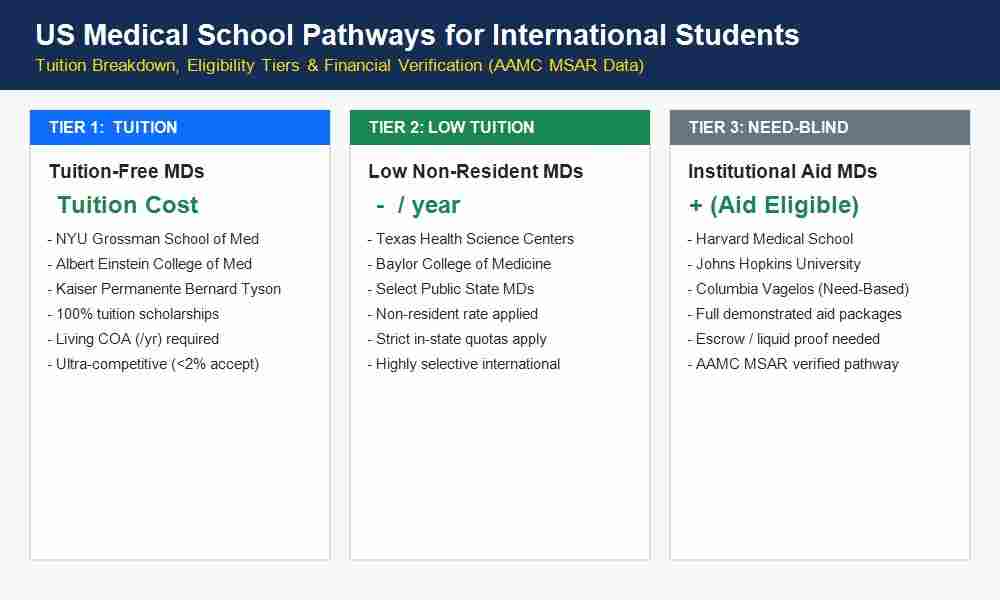
Tier 1: 100% Tuition-Free Medical Schools for International Students ($0 Tuition)
Tuition-free medical schools represent the single most economical route for international students admitted to U.S. medical programs. Philanthropic endowments eliminate standard tuition overhead for all enrolled candidates regardless of nationality or immigration status.
| Medical School | Location | Annual Tuition | International Policy | Estimated Living COA |
|---|---|---|---|---|
| NYU Grossman School of Medicine | New York, NY | $0 (Full Tuition) | Accepts International | $32,000 / year |
| Albert Einstein College of Medicine | Bronx, NY | $0 (Full Tuition) | Accepts International | $29,500 / year |
| Kaiser Permanente Tyson School of Med | Pasadena, CA | $0 (Tuition + Fees) | Accepts International | $34,000 / year |
| NYU Grossman Long Island School of Med | Mineola, NY | $0 (Primary Care) | Accepts International | $31,000 / year |
While tuition costs drop to $0, candidates remain legally obligated to prove living funds for their F-1 student visa. The U.S. Department of State mandates liquid documentation covering room, board, supplies, and clinical health coverage before issuing an I-20 document.
These institutions maintain overall acceptance rates under 1.8%, requiring exceptional academic metrics. Admitted non-citizens typically present median MCAT scores of 518 to 523 alongside significant clinical or bench research publications.
Tier 2: Most Affordable Private & Non-Resident Medical Schools
Private institutions with fixed tuition baselines offer predictable budgeting compared to public state medical centers. Non-resident tuition at standard public schools routinely escalates beyond private tuition caps when out-of-state fee multipliers apply.
| Medical School | Type | Non-Resident Tuition | Prerequisite Rule |
|---|---|---|---|
| Baylor College of Medicine | Private | $43,125 / year | U.S./Canadian Degree Preferred |
| UTRGV School of Medicine | Public (TX) | $37,850 / year | Strict Out-of-State Caps (10%) |
| Mayo Clinic Alix School of Medicine | Private | $64,000 / year | Extensive Merit Aid Available |
| Case Western Reserve University | Private | $69,800 / year | Institutional Loans Permitted |
| Stony Brook University Renaissance SOM | Public (SUNY) | $68,190 / year | Non-Resident Surcharge Applied |
For international applicants managing educational paperwork, digital conversion tools like our guide on how to convert Google Sheets to fillable PDFs free streamline transcript tracking and credential distribution.
Tier 3: Need-Blind & Need-Based Institutional Financial Aid Programs
Premier private institutions with multi-billion dollar endowments eliminate net attendance costs through need-based grants rather than upfront tuition waivers. When admitted, international students submit standardized financial declarations through CSS Profile or institutional portals to qualify for full need coverage.
- Harvard Medical School: Evaluates admitted international applicants through need-based calculation frameworks, matching institutional scholarship awards identically to domestic candidates.
- Columbia University Vagelos College of Physicians and Surgeons: Eliminates medical education debt by replacing all student loans with need-based grants for families demonstrating financial need.
- Johns Hopkins University School of Medicine: Provides direct institutional grants covering tuition and living allowances for candidates from lower and middle-income brackets.
- Yale School of Medicine: Commits institutional resources to meet 100% of demonstrated financial need for all matriculating medical students.
Admissions at these schools operate with extreme selectivity. Of the roughly 250 to 300 international students accepted nationwide each year, over 40% matriculate into these high-endowment institutions.
Mandatory Escrow Accounts & Proof of Funds Explained
U.S. medical schools legally require non-citizen matriculants to deposit 1 to 4 years of total cost of attendance (COA) into certified escrow accounts. International students cannot access U.S. Federal Direct Unsubsidized Loans or Grad PLUS Loans through FAFSA.
Before an academic institution issues immigration Form I-20 for an F-1 visa, candidates must satisfy one of three verification options:
Financial Verification Protocol for Non-U.S. Citizens:
- Full Liquid Escrow Deposit: Transferring $75,000 to $120,000 (Year 1 COA) into a university-managed escrow account prior to enrollment.
- Multi-Year Binding Bank Guarantee: Delivering an irrevocable letter of credit from an accredited financial institution guaranteeing up to 4 years of tuition payments.
- U.S. Co-Signer Private Educational Loan: Securing private financing through lenders such as Discover, Sallie Mae, or Earnest with a creditworthy U.S. citizen or permanent resident guarantor.
Failure to provide liquid verification within 30 to 60 days of admission acceptance results in administrative forfeiture of the seat.
Strategic Application Checklist for International Pre-Meds
Maximizing acceptance probability while minimizing non-refundable application expenditures requires disciplined administrative filtering. Follow this operational sequence during pre-application preparation:
| Phase | Timeline | Core Requirement & Benchmark |
|---|---|---|
| 1. Academic Audit | 18–24 Months Out | Complete 60–90 credit hours at an accredited U.S. or Canadian university; verify WES credential evaluation. |
| 2. Testing Benchmark | 12–15 Months Out | Target MCAT score of 516+ (92nd percentile minimum for competitive international pools). |
| 3. School Filtering | 6–9 Months Out | Filter the 48 active international-accepting programs via MSAR; exclude public institutions requiring state residency. |
| 4. Escrow Preparation | At Acceptance | Assemble certified liquid funds ($80,000–$100,000) or confirm institutional aid package before I-20 issuance. |
Frequently Asked Questions
-
Are there really 100 cheap medical schools in the USA for international students?
No, there are not 100 cheap medical schools for non-U.S. citizens. Only approximately 48 allopathic (MD) and 5 osteopathic (DO) programs accept international applications in total, and almost all charge full out-of-state tuition ($60,000 to $85,000+ per year) unless admitted to tuition-free institutions like NYU Grossman or Albert Einstein.
-
Can international students qualify for in-state medical school tuition in the US?
International students on non-immigrant visas (F-1) cannot qualify for state-subsidized in-state tuition rates. U.S. public medical schools strictly reserve in-state tuition for legal permanent residents or citizens who pay local state taxes. Non-residents must pay mandatory out-of-state tuition surcharges.
-
Can international students get financial aid or student loans for US medical schools?
International students cannot access U.S. federal student loans through FAFSA. Financial aid is limited to institutional scholarships, full-tuition endowments, or private student loans that require an eligible U.S. citizen co-signer with established credit history.
-
Why do U.S. medical schools require an escrow deposit for international students?
Medical schools require escrow deposits to guarantee students can complete their 4-year degree without defaulting due to currency restrictions or international financial insolvency. Without federal loan backing, institutions demand liquid proof of funds ($75,000 to $120,000 minimum) before issuing immigration Form I-20.

