


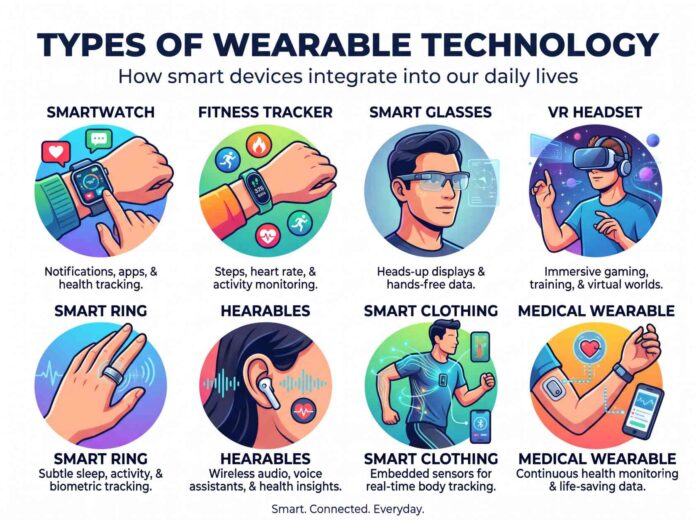
Wearable technology has changed how people track fitness, monitor health, and stay connected. You can now measure heart rate, track sleep, monitor blood glucose, and receive smartphone notifications through small devices worn on your body.
But not every wearable serves the same purpose. A smartwatch focuses on communication and daily activity. A smart ring tracks health data without a large screen. Smart clothing can measure body movement, and medical wearables help patients manage certain health conditions.
Some devices are built for everyday wellness. Others are regulated medical products that support clinical care.
This guide explains 8 types of wearable technology, their features, common uses, sensor accuracy, and limitations. It will help you choose a device that suits your lifestyle and health needs.
Wrist-Worn Wearables: Smartwatches vs. Fitness Trackers
Smartwatches and fitness trackers are two of the most popular wearable devices. Both can measure physical activity, heart rate, and sleep patterns.
The main difference is their purpose. Smartwatches combine health tracking with communication and apps. Fitness trackers focus more on activity, exercise, and daily health records.
1. Smartwatches (Active Connectivity and Apps)
<AsyncImage query=”modern smartwatch on wrist displaying fitness heart rate notifications AMOLED screen” aspectRatio=”16:9″ width=”100%”/>
A smartwatch is a wrist-worn computer that connects to your smartphone or mobile network. It combines fitness tools with digital features.
Most modern smartwatches offer:
- Heart rate monitoring: Tracks pulse during rest and exercise.
- GPS tracking: Records walking, running, and cycling routes.
- Sleep analysis: Estimates sleep duration and sleep stages.
- ECG features: Selected models can record a single-lead electrocardiogram.
- Notifications: Displays calls, messages, emails, and app alerts.
- LTE connectivity: Selected models support calls and internet access without a nearby phone.
- Voice assistants: Supports voice commands and hands-free tasks.
- AMOLED displays: Offers bright colours and clear text.
Some models include blood oxygen estimates, skin temperature sensors, fall detection, and emergency alerts.
Common uses of smartwatches
Smartwatches are useful for people who want fitness tracking and daily connectivity in one device.
Runners can track distance and heart rate. Office workers can check notifications without reaching for a phone. Older adults may benefit from fall alerts and emergency contact features, where supported.
Limitations
A smartwatch has a smaller battery than most smartphones. GPS, LTE, bright displays, and continuous sensor use can increase battery drain.
Its health readings are estimates. An ECG feature may record a limited heart rhythm trace, but it cannot replace a standard 12-lead ECG or a medical examination.
For example, Apple’s ECG app produces a recording similar to a single-lead ECG. It can help identify certain rhythm patterns, but it cannot detect every heart problem.
2. Fitness Trackers (Dedicated Recovery and Activity Logs)
<AsyncImage query=”slim fitness tracking band on wrist displaying daily steps heart rate sleep fitness statistics” aspectRatio=”16:9″ width=”100%”/>
A fitness tracker is a smaller wearable built mainly for physical activity and health monitoring.
Unlike a full smartwatch, many fitness bands have fewer apps and communication features. Their simple design can make them comfortable for continuous use.
Main features include:
- Daily step counting.
- Continuous or periodic heart rate monitoring.
- Sleep duration estimates.
- Exercise tracking.
- Calorie expenditure estimates.
- Blood oxygen measurements on selected models.
- Activity reminders.
- Basic smartphone notifications.
Some fitness bands offer battery life of several days or longer. Actual battery life depends on the model, display, GPS use, and sensor settings.
Fitness band vs. smartwatch for continuous heart rate monitoring
| Feature | Fitness Tracker | Smartwatch |
|---|---|---|
| Heart rate tracking | Common | Common |
| Step counting | Yes | Yes |
| Sleep tracking | Yes | Yes |
| GPS | Model dependent | More widely available |
| Calling and apps | Limited | Extensive on selected models |
| Display | Usually smaller | Usually larger |
| Battery life | Often longer | Often shorter |
| Price | Usually lower | Available across many price ranges |
A fitness band may suit someone who wants simple activity records and fewer distractions. A smartwatch is better for someone who needs apps, navigation, calls, and more interactive features.
Neither form guarantees more accurate heart rate readings. Sensor quality, fit, skin contact, and movement matter more than the product category alone.
3. Sensor Breakthroughs: Optical PPG, ECG, and Non-Invasive Glucose Metrics
Wearable devices use several sensor types to collect information from the body.
Understanding these technologies helps explain why some readings are useful for daily tracking but not suitable for medical decisions.
Optical PPG sensors
Photoplethysmography (PPG) is a common method used in smartwatches, fitness bands, and smart rings.
Here’s how it works:
- Small LEDs shine light into the skin.
- Blood absorbs and reflects light as its volume changes with each heartbeat.
- A photodetector measures changes in reflected or transmitted light.
- Software analyses the signal to estimate pulse rate.
Green light is commonly used for wrist heart rate tracking. Red and infrared light may support other measurements.
PPG works well under many resting conditions. But motion, poor sensor contact, temperature, and changes in blood flow can affect its readings. Accuracy can fall during intense workouts or resistance training.
ECG sensors
An electrocardiogram measures the electrical signals produced by the heart.
Some smartwatches use electrodes to record a short ECG. A user may need to touch the watch’s crown or another electrode during the recording.
This is different from PPG. PPG measures changes in blood volume, whereas ECG records electrical activity.
Non-invasive glucose monitoring
Many people would like a smartwatch that measures blood glucose without needles or skin sensors.
Research is exploring optical methods, spectroscopy, and other sensor technologies. But there is an important safety issue.
The US FDA states that it has not authorised, cleared, or approved any smartwatch or smart ring that independently measures or estimates blood glucose without piercing the skin. Do not use such products to make diabetes treatment decisions.
A smartwatch app that displays readings from an authorised continuous glucose monitor is different. The actual glucose measurement still comes from the separate medical sensor.
Discrete Biometric Trackers: Smart Rings and Smart Clothing
Not everyone likes wearing a large device on the wrist. Smart rings and connected clothing offer other ways to collect body and movement data.
These devices are often designed to fit into daily routines without requiring frequent screen interaction.
4. Smart Rings (Screenless Sleep and HRV Tracking)
<AsyncImage query=”smart health tracking ring close up on finger minimalist fitness technology product photograph” aspectRatio=”16:9″ width=”100%”/>
Smart rings are small electronic devices worn on a finger. They use miniature sensors to collect information about sleep, heart rate, temperature trends, and daily activity.
Popular health and fitness rings usually work with a smartphone app. The ring collects data, and the app presents it through charts and daily summaries.
Common smart ring features:
- Resting heart rate tracking.
- Heart rate variability (HRV) estimates.
- Sleep duration and sleep-stage estimates.
- Skin temperature trends.
- Activity and movement tracking.
- Recovery and readiness scores.
One advantage is comfort during sleep. People who dislike wearing a watch at night may find a small ring easier to use.
Smart ring vs. smartwatch sleep tracking accuracy
This is one of the most common wearable comparisons.
Smart rings often measure from the finger, where sensor contact and blood flow can differ from wrist measurements. This can help with some resting measurements.
But it does not prove that every smart ring is more accurate than every smartwatch.
A 2024 study compared Oura Ring Gen3, Fitbit Sense 2, and Apple Watch Series 8 against laboratory polysomnography in 35 healthy adults.
The study found:
- All three devices had at least 95% sensitivity for detecting sleep.
- Sleep-stage classification varied between devices.
- Oura showed sensitivity of approximately 76–80% across the measured sleep stages.
- Apple Watch results varied between approximately 51% and 86%.
The researchers found differences between the devices and the medical sleep test. (Published study in PMC)
The practical lesson is simple: smart rings can be useful for tracking sleep patterns over time, but their sleep-stage readings are estimates. They cannot replace a medical sleep study.
Who should choose a smart ring?
A ring may suit people who want:
- Screen-free health tracking.
- Overnight comfort.
- Resting heart rate and HRV trends.
- A discreet wearable.
- Fewer notifications during the day.
Check sizing carefully. A loose ring can affect sensor contact, and your finger size may change with temperature or swelling.
5. Smart Clothing and Connected E-Textiles
<AsyncImage query=”smart textile wearable technology athlete connected sensor shirt ECG fitness monitoring garment” aspectRatio=”16:9″ width=”100%”/>
Smart clothing uses sensors and electronic components built into fabric or garments.
Unlike watches and rings, these systems can collect measurements across larger areas of the body.
Connected clothing may include:
- Conductive threads and flexible electronic circuits.
- Heart rate and ECG electrodes.
- Muscle activity sensors.
- Motion and posture sensors.
- Pressure and breathing sensors.
- Wireless communication modules.
Some research garments use electromyography (EMG) sensors to study muscle activation. Others use textile electrodes to measure heart activity.
Common uses of smart clothing
Sports and fitness: Athletes can study muscle movement, posture, and physical performance.
Rehabilitation: Sensors can track movement during recovery after injury.
Healthcare: Special garments may collect ECG, breathing, or other body signals for remote monitoring.
Workplace safety: Smart clothing may track posture and movement during physically demanding tasks.
Smart clothing sensor washing machine durability
Washing is one of the biggest challenges for connected textiles.
Normal garments are exposed to water, detergent, heat, and repeated mechanical movement. These conditions can damage electronic threads, sensors, or wiring.
Research on e-textiles identifies a lack of consistent washing test standards as a major barrier to wider use. (Textile Research Journal)
Before purchasing smart clothing, check:
- Whether the battery or electronic module can be removed.
- Whether machine washing is permitted.
- The maximum washing temperature.
- Whether tumble drying is allowed.
- The expected number of wash cycles.
- Whether the manufacturer offers sensor replacement.
Never assume that a smart shirt is machine washable just because it looks like ordinary clothing.
Immersive and Spatial Wearables: VR Headsets and Smart Glasses
Smart glasses and VR headsets place digital information in front of your eyes. But they offer very different experiences.
Smart glasses are often designed for daily use. VR headsets focus on immersive digital environments.
6. Smart Glasses and AR Eyewear
<AsyncImage query=”modern augmented reality smart glasses transparent heads up display person wearing glasses” aspectRatio=”16:9″ width=”100%”/>
Smart glasses look similar to ordinary eyewear but include electronic features.
Depending on the model, they may include a camera, microphone, speakers, touch controls, or a small display.
AR glasses go a step further by placing digital information over the user’s view of the physical environment.
Common features include:
- Heads-up information displays.
- Open-ear audio speakers.
- Voice commands.
- Camera and video recording.
- Real-time translation on supported models.
- Navigation prompts.
- AI assistance.
- Prescription lens options on selected products.
Common applications
Smart glasses can help with hands-free calls, navigation, translation, photography, and quick access to information.
In business settings, AR glasses can help technicians view instructions while working on equipment. They may support remote assistance, training, and industrial maintenance.
Smart glasses vs. VR headset: Battery life and everyday usability
Smart glasses are usually lighter than VR headsets. Many are intended for short interactions throughout the day rather than long immersive sessions.
Battery performance varies based on camera use, audio, display brightness, and processor load. Some models depend on a connected phone or external battery pack.
Privacy is another concern. A camera-equipped pair of glasses may record people nearby. Follow local privacy rules and respect consent when recording.
7. VR and Mixed Reality (MR) Headsets
<AsyncImage query=”virtual reality mixed reality headset person using spatial computing immersive 3D environment” aspectRatio=”16:9″ width=”100%”/>
Virtual reality headsets create a digital environment around the user. They cover or replace much of the physical view with computer-generated visuals.
Mixed reality adds digital objects to a view of the physical environment. Advanced headsets use cameras and sensors to support this experience.
Main features include:
- High-resolution displays.
- Motion and spatial tracking.
- Hand and controller input.
- Eye tracking on selected models.
- Virtual screens and 3D objects.
- Passthrough video for viewing the surrounding room.
- Spatial audio.
VR and MR applications
Gaming: Users can interact with fully immersive games.
Education: Students can explore 3D models, virtual labs, and simulated environments.
Healthcare training: Medical teams can practise selected procedures in virtual simulations.
Remote work: Teams can meet in virtual spaces and work with shared 3D models.
Industrial design: Engineers can inspect equipment and digital prototypes.
VR headsets are generally heavier and more demanding than everyday smart glasses. They may cause eye strain, motion discomfort, or fatigue during long sessions.
Take breaks and adjust the headset correctly. People with balance problems or motion sensitivity should be cautious when using immersive experiences.
Audio and Specialized Health: Hearables and Clinical Medical Wearables
Some wearables focus on sound and hearing. Others are built for medical measurements that may guide treatment.
These categories show how wearable technology goes beyond ordinary fitness tracking.
8. Hearables (Smart Earbuds)
<AsyncImage query=”wireless smart earbuds wearable biometric heart rate monitoring technology close up” aspectRatio=”16:9″ width=”100%”/>
Hearables are wireless earbuds or hearing devices with connected electronic features.
Basic models focus on audio. Advanced products may include microphones, noise control, motion sensors, or biometric monitoring.
Common features include:
- Active noise cancellation (ANC).
- Transparency or ambient sound mode.
- Voice assistant access.
- Calls and music streaming.
- In-ear heart rate monitoring on selected products.
- Temperature and movement sensing in research systems.
- Hearing support features on compatible products.
The ear canal offers an interesting place for biometric measurement. It can provide a stable sensor location during certain activities.
Some research has studied optical PPG sensors inside earbuds. A study involving 22 participants found that a Jabra earbud heart-rate monitor performed well against a chest strap during several exercise tests. The results were device-specific, so they should not be applied to every smart earbud. (Research study on earbud heart rate accuracy)
Hearables may suit runners, cyclists, and people who prefer listening to audio during exercise.
But fit matters. A poorly fitted earbud can affect comfort, audio quality, and sensor readings.
Clinical Medical Wearables
<AsyncImage query=”medical wearable technology continuous glucose monitor arm sensor ECG patch and insulin pump devices” aspectRatio=”16:9″ width=”100%”/>
Clinical medical wearables are designed to measure health conditions or support medical treatment.
Unlike ordinary fitness trackers, these products may be regulated as medical devices. They are tested against defined requirements for their intended use.
Important examples include:
Continuous Glucose Monitors (CGMs)
CGMs track glucose levels throughout the day and night. A small sensor sits under the skin and measures glucose in the interstitial fluid.
The readings are sent to a compatible receiver, phone, or insulin pump.
People with diabetes may use CGMs to understand glucose trends and support treatment decisions.
Wearable ECG patches
Medical ECG patches attach to the chest and record heart electrical activity over an extended period.
Doctors may use them to investigate irregular heart rhythms that do not appear during a short clinic ECG.
The Zio XT ECG Monitoring System is one example listed in the FDA’s 510(k) database.
Automated insulin delivery systems
These systems combine glucose monitoring with an insulin pump. Depending on the system, software can adjust insulin delivery based on glucose readings.
Such systems are medical devices and must be used according to their authorised instructions and a clinician’s care plan.
Consumer Medical Wearables: Understanding FDA Approval Criteria
A common mistake is assuming that every smartwatch with a health feature is an FDA-approved medical device.
That is not correct.
In the United States, the FDA uses different regulatory pathways according to the device’s risk and intended use.
| Regulatory Pathway | Meaning |
|---|---|
| 510(k) Clearance | Shows substantial equivalence to a legally marketed medical device |
| De Novo Authorization | Provides a pathway for certain new low- to moderate-risk devices without a suitable predicate |
| Premarket Approval (PMA) | A rigorous review pathway for high-risk medical devices |
A low-risk wellness product may fall outside the medical device requirements when its claims relate to general fitness and lifestyle rather than diagnosing or treating a disease. The FDA updated its general wellness guidance in January 2026.
How to check a wearable’s medical status:
- Find the exact product name and model.
- Identify the medical purpose claimed by the manufacturer.
- Search the FDA’s medical device database.
- Check whether the product has a 510(k), De Novo, or PMA record.
- Read the authorised intended use and limitations.
- Confirm that the feature is available in your country.
An FDA registration or listing is not proof of approval or clearance. The FDA makes this distinction clear in its consumer device guidance.
For readers outside the United States, check the medical device regulator in your own country. FDA status does not automatically establish approval in every market.
Wearable Technology Accuracy: What Should You Trust?
Accuracy is one of the most important factors when choosing a wearable.
A device may measure one metric well and perform poorly with another. For example, a smartwatch may track resting heart rate reliably but produce less reliable readings during strength training.
Here is a practical overview:
| Measurement | Common Wearable | Main Limitation |
|---|---|---|
| Steps | Smartwatch / fitness band | Arm movement can affect counts |
| Resting heart rate | Watch / ring | Fit and circulation matter |
| Exercise heart rate | Watch / hearable | Movement can affect optical readings |
| Sleep duration | Ring / smartwatch | Wake periods may be missed |
| Sleep stages | Ring / smartwatch | Estimates vary from medical testing |
| HRV | Ring / smartwatch | Affected by timing and measurement method |
| Blood oxygen | Selected watches and rings | Not a replacement for clinical testing |
| Blood glucose | Medical CGM | Uses a sensor beneath the skin |
| ECG | Watch / medical patch | Depends on device design and intended use |
For everyday tracking, wearables are useful for observing trends. But an unusual reading should not be treated as a diagnosis.
If a device shows repeated abnormal readings or symptoms concern you, discuss them with a healthcare professional.
How to Choose the Right Wearable Technology
The best wearable is the one that fits your main goal, comfort, budget, and data needs.
Use this guide:
| Your Main Goal | Suitable Wearable |
|---|---|
| Calls, notifications, and fitness | Smartwatch |
| Steps and simple activity tracking | Fitness band |
| Sleep and resting health trends | Smart ring |
| Muscle movement and posture analysis | Smart clothing |
| Hands-free information and navigation | Smart glasses |
| Immersive gaming and virtual training | VR/MR headset |
| Music and workout audio | Hearables |
| Diabetes or heart monitoring | Clinically authorised medical wearable |
Before buying, check sensor quality, battery life, phone compatibility, subscription charges, comfort, data privacy, and warranty.
For medical use, check the exact regulatory status and intended purpose. Do not rely on advertising phrases such as “medical grade” without supporting evidence.
Final Thoughts: Which Type of Wearable Technology Is Best?
Wearable technology now includes far more than smartwatches and fitness bands.
Smart rings make health tracking discreet. Smart clothing can measure body movement. Smart glasses bring digital information into your field of view, and VR headsets support immersive experiences.
Hearables combine audio with selected biometric features. Clinical wearables take things further by helping patients and healthcare teams monitor medical conditions.
Each category has its own strengths and limits. Some focus on comfort, others on connectivity, and some are built for medical care.
Before choosing a device, decide what you want it to measure or do. Check how well its sensors perform, read its limitations, and verify medical claims through reliable sources.
The right wearable should make daily life easier and provide useful information without making you depend on every number it displays.

