


Welcome back to the moon! If you’ve been following the latest trends in space exploration, you know that humanity is on the brink of making history once again. Over 50 years since the Apollo era, we are finally heading back to deep space, and the excitement worldwide is palpable.
If you are frantically Googling “when is artemis 2 launching?” you are not alone. The highly anticipated nasa artemis ii launch is officially scheduled for tomorrow, April 1, 2026.

Let’s dive into all the critical details of this monumental artemis launch, from the colossal rocket to the historic crew, and what this means for our future among the stars.
When is Artemis 2 Launching? The Exact Details
After rigorous testing, wet dress rehearsals, and weather evaluations, NASA has confirmed that the wait is finally over. The nasa artemis rocket launch is slated for Wednesday, April 1, 2026.
The two-hour launch window opens exactly at 6:24 PM EDT (22:24 UTC). NASA will be providing wall-to-wall live coverage on NASA+, YouTube, and their social media channels starting hours beforehand. If weather (like high winds or thick cloud coverage) or technical hiccups occur, NASA has daily backup launch windows extending through April 6.+2
The Launchpad: Kennedy Space Center
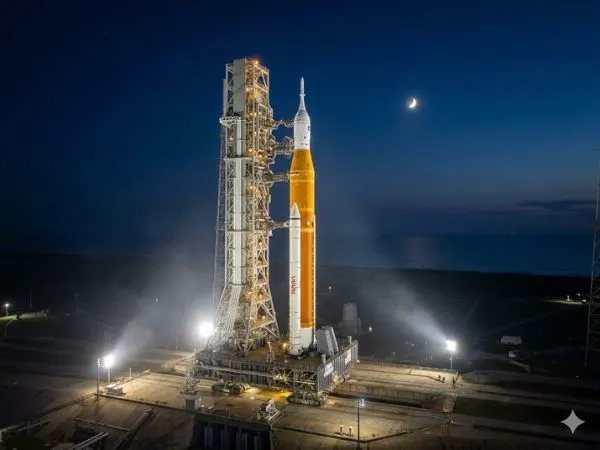
Where is all the magic happening? The historic Launch Complex 39B at the kennedy space center in Florida. This is the exact same hallowed ground that launched the Apollo missions and the Space Shuttle.
Towering over the Florida coast is the Space Launch System (SLS)—the most powerful rocket NASA has ever flown—topped by the Orion spacecraft. Stacking and final preparations are completely wrapped up, the crew is in quarantine, and the massive vehicle is just waiting for the countdown.
also read : – How Many Countries Are There in the World? Let’s Find Out!
Meet the Historic Artemis II Crew
This mission isn’t just a triumph of engineering; it’s a triumph of humanity. The four-person crew represents a new, diverse era of space exploration:
- Commander Reid Wiseman: A veteran NASA astronaut leading the first crewed lunar flight in half a century.
- Pilot Victor Glover: Making history as the first person of color to fly to the moon.
- Mission Specialist Christina Koch: Setting a milestone as the first woman to travel beyond low Earth orbit.
- Mission Specialist Jeremy Hansen: Representing the Canadian Space Agency, he will become the first non-American to venture to the moon.
What is the Mission Plan for this Artemis Launch?
Unlike the upcoming Artemis III mission, Artemis II will not land on the moon’s surface. Instead, this is a daring 10-day, high-speed test flight designed to push the Orion spacecraft’s life-support, propulsion, and communication systems to their absolute limits with humans finally aboard.+1
Here is the quick breakdown of the flight path:
- Earth Orbit Checkouts: After blasting off from the kennedy space center, the crew will spend about 24 hours in a high Earth orbit (roughly 230 miles up) testing critical life-support systems.
- Translunar Injection: The rocket’s upper stage will fire, propelling Orion out of Earth’s orbit and toward the moon.
- The Lunar Flyby: The spacecraft will trace a “free-return” trajectory around the far side of the moon, traveling roughly 4,700 miles beyond the lunar surface. At this point, the crew will be further from Earth than any humans have been since Apollo 13!+1
- Splashdown: The spacecraft will use the moon’s gravity to slingshot back home, ending with a blistering 25,000 mph re-entry—testing the critical heat shield—and a splashdown in the Pacific Ocean around April 10, 2026.
Why the NASA Artemis II Launch Matters
The nasa artemis ii launch is the ultimate proving ground. By successfully flying humans around the moon and returning them safely, NASA will clear the way for Artemis III—the mission that will finally put boots back on the lunar dust. Ultimately, the Artemis program aims to establish a permanent human presence near the lunar South Pole, acting as a stepping stone for our next giant leap: sending humans to Mars.
So, set your alarms, bookmark the live streams, and get ready to witness history tomorrow evening. The golden age of space exploration is back!

