


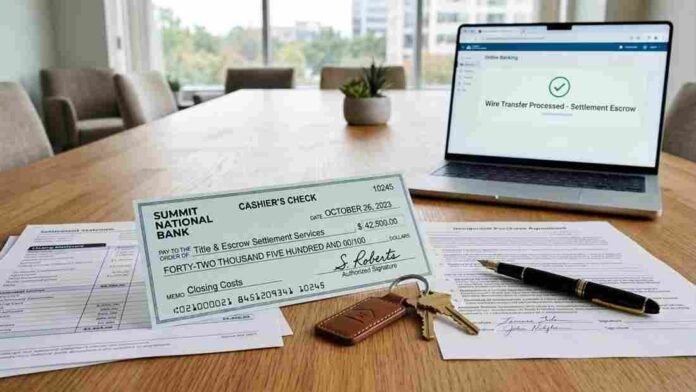
A wire transfer is the universally preferred and fastest method for paying house closing costs, while a cashier’s check is a viable secondary alternative accepted only by select title and settlement companies. Settlement agents favor electronic Fedwire transfers because cleared funds reflect directly in their escrow trust accounts within 1 to 4 hours, allowing deeds to record and keys to disburse immediately. Conversely, while a cashier’s check guarantees bank funds, title companies face rampant counterfeit cashier’s check fraud and commonly enforce a mandatory 24- to 72-hour hold under the Expedited Funds Availability Act before releasing ownership.
State “good funds” statutes strictly forbid escrow officers from recording property transfers or disbursing seller proceeds until homebuyer funds clear irrevocably. Choosing between a cashier’s check and an electronic wire directly dictates whether your real estate transaction closes on schedule or stalls at the settlement table.
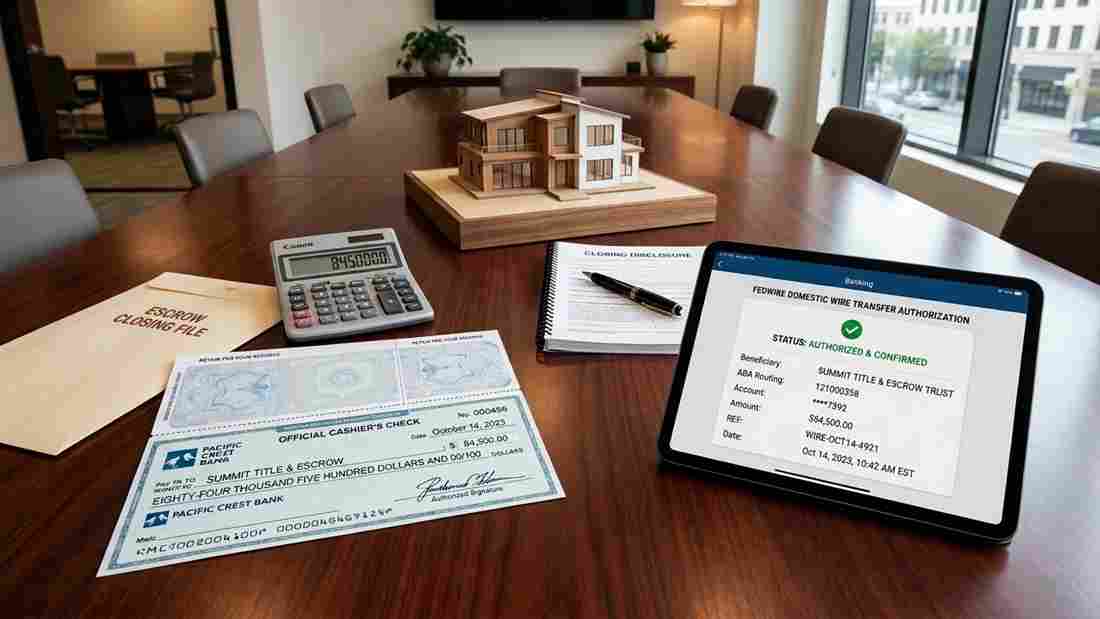
Core Financial Comparison: Cashier’s Check vs. Wire Transfer
Settlement policies vary substantially across title companies, escrow attorneys, and commercial banking institutions. Before committing to a disbursement method, review the operational differences across clearing speed, cost, verification protocols, and security risks.
| Comparison Metric | Bank Wire Transfer | Official Cashier’s Check |
|---|---|---|
| Primary Settlement Speed | Immediate (1 – 4 hours same-day) | 1 – 3 business day clearing hold |
| Escrow Title Acceptance | Universally mandatory or preferred | Restricted (capped under $5,000–$10,000) |
| Standard Bank Fee | $20 – $40 outbound fee | $8 – $15 (Free for premium tiers) |
| Risk of Closing Delay | Extremely Low (if initiated before cutoff) | High (due to verification / holds) |
| Handling Amount Fluctuations | Overpayments refunded electronically | Requires physical check re-issuance |
| Primary Security Threat | Email wire fraud & spoofed instructions | Physical theft, loss & counterfeit scams |
| Reversibility Once Issued | Irrevocable once settled on Fedwire | Requires 90-day indemnity bond if lost |
When preparing personal or business finances for major acquisitions, structuring cash flow is critical. Review our detailed guides on how to calculate working capital and strategic tips to get approved for a mortgage before your settlement date arrives.
Why Most Title and Escrow Companies Require Wire Transfers
Title insurance underwriters operate under state “Good Funds” legislation prohibiting the disbursement of loan proceeds and purchase balances without guaranteed cleared funds. In states such as California, Texas, Florida, and Ohio, escrow officers face civil liability and revoked licenses if they record a deed against uncollected check drafts.
Three primary underwriting realities explain why wires dominate residential and commercial closings:
- Instant Finality on the Fedwire Network: Federal Reserve wire transfers settle instantaneously on an irrevocable gross settlement basis. Once received by the escrow trust bank, funds cannot be recalled, stopped, or dishonored.
- Combating Counterfeit Check Scams: Advanced color laser printing has enabled criminal syndicates to forge legitimate-looking cashier’s checks with genuine routing numbers. Title companies that accepted fraudulent checks historically lost six-figure balances when checks bounced days after closing.
- Mandatory 10-Day Indemnity Waiting Periods: Under Uniform Commercial Code (UCC) Section 3-312, if a buyer loses a cashier’s check or it is stolen in transit, the issuing bank does not re-issue or refund the money immediately. The bank imposes a mandatory 90-day claim waiting period or requires an expensive indemnity bond, virtually collapsing the real estate contract.
When a Cashier’s Check Is Acceptable (And Practical Guidelines)
A cashier’s check remains an acceptable instrument when closing figures are under institutional policy caps or when local escrow offices can physically verify funds before settlement. If you opt for or are permitted to use a cashier’s check, adhere to strict procedural guidelines:
- Verify Dollar Threshold Limits: Many title companies accept cashier’s checks only up to $5,000 or $10,000. Sums exceeding this threshold strictly require an electronic wire. Contact your closing attorney or escrow officer in writing 7 business days before closing.
- Exact Payee Designation: Instruct your bank teller to make the cashier’s check payable directly to the legal name of the title company’s escrow account (e.g., “First American Title Company – Escrow Trust Account”). Never make checks payable to the seller personally, the real estate agent, or yourself with an endorsement.
- Handle Last-Minute Settlement Statement Adjustments: The final Closing Disclosure (CD) figure frequently changes within 24 hours of closing due to prorated property taxes, HOA adjustments, or utility credits. If your cashier’s check is for $45,500 but final closing requires $45,320, the title company accepts the check and issues an immediate escrow refund check for the $180 difference.
- Deliver the Physical Check 24 Hours Early: Hand-deliver the cashier’s check to the title company branch at least one full business day prior to loan funding so the escrow officer can call the issuing bank’s corporate verification department to validate authenticity.
Wire Fraud Defense: The 4-Step Verification Protocol
Real estate wire fraud is one of the fastest-growing cybercrimes in the United States, stealing over $400 million annually from homebuyers according to FBI IC3 reports. Hackers compromise real estate agent, broker, or attorney email servers, monitor closing calendars, and send spoofed emails with “updated” wire routing instructions directing funds into offshore or mule accounts.
The Golden Rule of Escrow Wire Security
NEVER wire funds based on an email notification alone. Legitimate title companies almost never change wire instructions mid-transaction. Treat any email alleging “last-minute banking changes” as an active cyber fraud attempt.
Execute this four-step authentication playbook before executing your wire:
- Establish Trusted Voice Verification Upfront: During your initial contract intake, record the direct office telephone number of your assigned escrow officer from a verified business card or independent Google listing. Never use phone numbers listed in wire instruction emails.
- Call to Verbally Verify Every Digit: Before walking into your bank branch or approving online wire authorization, call your escrow officer directly. Read aloud the bank name, ABA 9-digit routing number, escrow account number, and exact beneficiary title.
- Initiate Early in the Morning (Before Bank Cutoff): Commercial banks enforce Fedwire processing cutoff times between 2:00 PM and 4:30 PM EST. Sending your wire prior to 11:00 AM guarantees same-day credit and provides a recovery window if transmission errors occur.
- Obtain the Federal Reserve IMAD / OMAD Number: Once your bank initiates the transfer, request the 16-to-22 character Input/Output Message Accountability Data (IMAD/OMAD) tracking number. Supply this tracking code to your escrow officer so their treasury department can locate the inbound wire in real time.
For high-value business transfers and alternative payment channels, consult our detailed analysis on Zelle daily and monthly sending limits for business accounts and our tax overview on 1099-NEC contractor credit card payments.
What If You Overpay or Underpay at Closing?
Overpaying or underpaying closing costs is extremely common due to property tax recalculations and dynamic per diem mortgage interest. Both instruments resolve balances differently:
- Overpayment Resolution: If you wire $52,000 and final closing figures tally $51,450, the title company prints an escrow check or issues an immediate direct deposit refund of the $550 excess at the signing table.
- Underpayment Resolution: If an unexpected recording fee creates a small shortage (e.g., $150 to $500), most title companies permit buyers to write a personal check or use a debit card for minor balances, provided the primary five- or six-figure sum cleared via wire.
-
Can I use a cashier’s check instead of a wire transfer for closing costs?
Yes, but only if your specific title company explicitly approves it and the amount falls below their internal threshold. Many title companies cap cashier’s checks at $5,000 or $10,000 and mandate wire transfers for larger amounts due to check fraud and state good funds laws.
-
How long does a wire transfer take to clear for house closing?
Domestic Fedwire transfers typically clear within 1 to 4 hours on the same business day. Initiating the wire before your bank’s morning cutoff time guarantees funds reach the title company’s escrow account in time for same-day recording and key release.
-
What happens if a cashier’s check for closing costs is lost or stolen?
You cannot get an immediate refund or replacement from the bank. Under UCC Section 3-312, banks require an indemnity bond or enforce a mandatory 90-day statutory waiting period before replacing lost cashier’s checks, which will delay or cancel your property closing.
-
Why are title companies so strict about wire fraud instructions?
Real estate wire fraud causes hundreds of millions of dollars in losses annually through spoofed email phishing scams. Because wire transfers cannot be reversed once processed through the Federal Reserve, title companies require independent verbal phone confirmation of all routing and account digits.
-
What should I do if my final closing cost amount changes after sending a cashier’s check?
If you slightly overpay, the title company issues an immediate refund check at the closing table for the difference. If you slightly underpay, most settlement companies permit a personal check or secondary transfer for minor balances under $500.

