


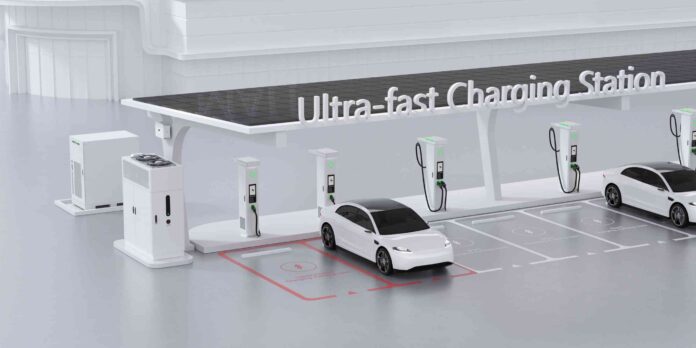
For a distribution center with limited transformer headroom, equipment decisions must follow the required service and the conditions of the actual site. Charging buses, delivery vans and electric logistics vehicles requires infrastructure shaped around routes, departure times and fleet energy use. Huawei Digital Power’s smart-charging portfolio combines DC power conversion, liquid-cooled high-current dispensers and managed allocation of charging capacity. In this context, commercial vehicle charging brings together specific components and controls rather than a single isolated device.
A distribution center has to allocate electricity among building operations, refrigeration and fleet charging under the same service limit. Equipment ratings, control policies and the responsibilities of the operating team should therefore be aligned before commissioning. A design assumption should be documented when it cannot yet be confirmed by measurements.
Fleet-oriented charging layout
Depot charging starts with a route-energy model: expected distance, consumption, battery reserve and available dwell time. The number of connectors should follow simultaneous vehicle demand, while the DC power system should be sized against realistic charging schedules.
Split charging infrastructure locates conversion cabinets separately from the parking stands. This can simplify traffic circulation in a depot, provided cable reach, pedestrian separation, protective bollards and service access are included in the layout.
Power sharing and schedules
Charging controls should distinguish total installed charger power from the site import limit. A 24-hour energy calculation can look acceptable while the busiest arrival window still exceeds transformer capacity, so interval-based demand analysis is necessary.
The monitoring platform can combine charger status, session energy and vehicle schedules. Operationally useful reports flag missed charging targets and recurring equipment faults rather than displaying utilization alone.
High-current equipment and safety
Liquid-cooled charging dispensers can support high-current delivery while managing cable temperature. The cooling circuit, connector contacts and sensing devices require inspection because fleets may use charging hardware repeatedly throughout the day.
Electrical design should include appropriate isolation, earthing, overcurrent protection and emergency stops. An equipment fault must not disable the entire depot if the planned segmentation and redundancy allow individual charging lanes to be isolated.
Practical scaling
Energy storage may be considered to smooth short peaks, but its economic value depends on local network tariffs, cycling, backup requirements and charger utilization. The storage controller must preserve its own safety constraints.
Fleet charging performance is measured by vehicles ready on time, successful sessions, delivered kilowatt-hours and manageable peak demand. These outcomes connect infrastructure design directly with transport operations.
These considerations show why commercial vehicle charging should be specified by its architecture, operating limits and interfaces. The charging hardware is only one layer of a commercial fleet project. Reliable outcomes depend on a matching of power electronics, operational schedules, vehicle compatibility and a traffic layout that works in daily use. The final selection still depends on applicable standards, actual site conditions and model-specific documentation.

