


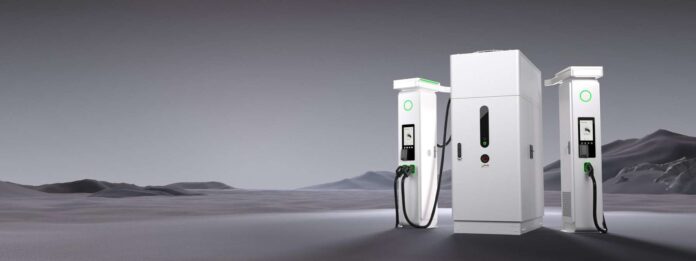
Sites serving customers throughout the day experience peaks that are difficult to predict from a simple daily energy estimate. For commercial charging station, system interfaces shape the real outcome. Huawei FusionCharge provides liquid-cooled ultra-fast charging technology for public, inter-city, and fleet installations. A commercial charging station can combine a DC power unit, one or more dispensers, and station-level management, with the final layout selected according to its business and electrical conditions.
Build the complete electrical path
Station equipment extends beyond the dispenser visible to drivers. The installation requires utility supply, protective switchgear, conversion modules, metering, control communications, and safe distribution to each charging outlet.
An equipment layout that separates the DC power unit from dispensers can offer flexibility in positioning bays. Cable losses, protective devices, access for service staff, and site geometry still need detailed review.
Understand power sharing and liquid cooling
The FusionCharge power-sharing matrix can allocate available converter capacity among outlets as vehicle current requests change. This is particularly relevant when several bays are occupied but not all batteries accept peak power.
The liquid-cooled dispenser provides a thermal path for high-current charging components. Huawei cites an 800 A dispenser rating under specified conditions, but actual power depends on voltage, vehicle limits, and the charger configuration.
Connect operations with energy management
Charger monitoring should record equipment availability, faults, start failures, delivered energy, and session duration. Separating charging time from time spent parked helps determine where capacity is being wasted.
A site-level demand controller may cap total import or adjust power allocation when more vehicles arrive. Such logic needs to respect utility agreements and avoid unexpected interruptions to customer sessions.
Solar power can contribute to daytime charging but remains weather-dependent. Storage dispatch, charger scheduling, and grid imports therefore require coordinated controls rather than independent equipment settings.
For an expansion, the original utility application and cable route drawings should be checked before new stalls are promised. A larger set of dispensers may share the same power pool and therefore change peak-hour experience.
Prepare for uptime and future expansion
Commissioning should include tests with different vehicle types, simultaneous charging, protective shutdowns, communications loss, and recovery after maintenance. These activities validate station behavior under realistic operating conditions.
Operators should establish clear responsibilities for customer support, onsite repair, remote diagnostics, and periodic inspection. A station may have electrical capacity available yet lose revenue from an unresolved connector fault.
Useful performance indicators include station occupancy, sessions per bay, successful start rate, energy throughput, and the frequency of derating. Together these show whether hardware and site management are working as intended.
A commercial charging station is a coordinated electrical service, not just a collection of charging stalls. Its performance comes from the interplay of power conversion, cooling, site control, customer access, and the ability to maintain equipment over time. For commercial charging station, Any claimed benefit should be assessed under realistic loads, environmental conditions, and the local operating policy.

