



No, you do not need to issue a Form 1099-NEC to an independent contractor if you paid them using a credit card, debit card, gift card, or third-party payment network. Under Internal Revenue Code (IRC) Section 6050W, the merchant acquiring bank or payment settlement entity (such as Stripe, Square, PayPal, or Venmo for business) holds the statutory obligation to report those transactions to the IRS on Form 1099-K. Filing a Form 1099-NEC for card-settled transactions creates duplicate taxable income in IRS automated matching systems, triggering audit notices for your contractor and administrative penalties for your business.
This statutory exemption applies regardless of how much you paid the vendor during the calendar tax year. Even if you disbursed $50,000 to a sole proprietor solely through your corporate Visa or Mastercard, your company must file zero 1099-NEC forms for those payments.
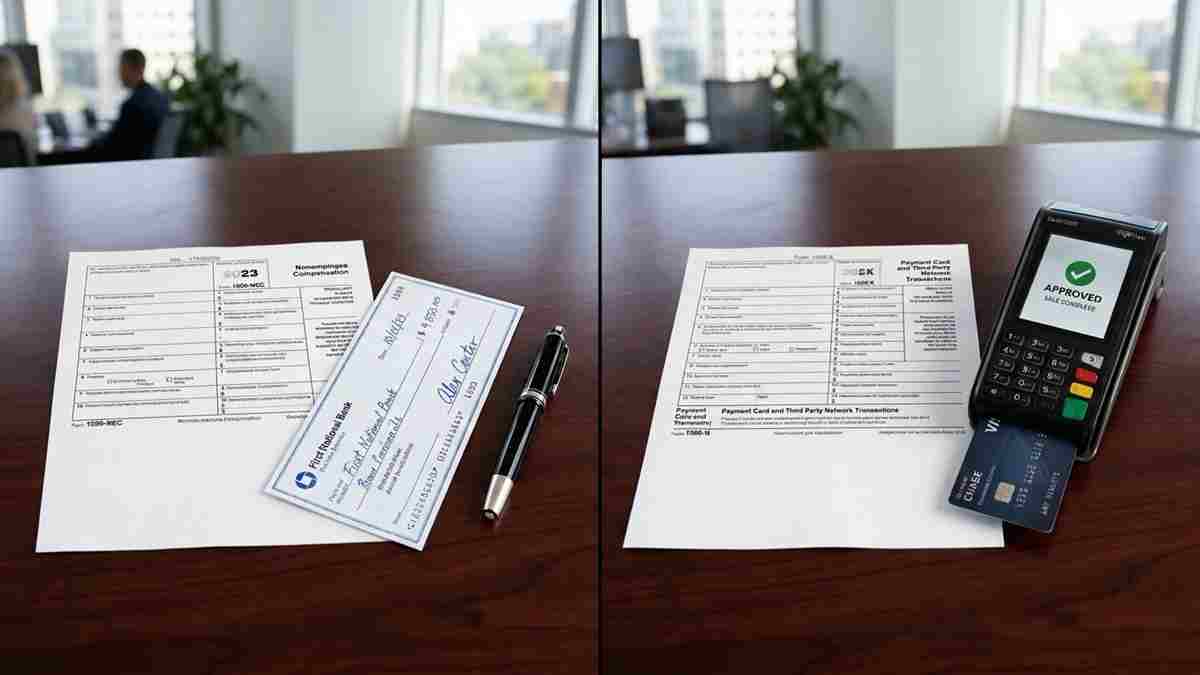
The Statutory Rule: IRC Section 6050W and the 1099-K Exemption
IRS regulations enforce a strict hierarchy between Form 1099-NEC and Form 1099-K to eliminate double-counting in national revenue audits. Enacted under the Housing and Economic Recovery Act and codified under IRS Instructions for Form 1099-MISC and 1099-NEC, IRC Section 6050W governs payments made through payment card networks and Third-Party Settlement Organizations (TPSOs).
The IRS explicitly instructs business payers:
“Payments made with a credit card or payment card and certain other types of payments, including third-party network transactions, must be reported on Form 1099-K by the payment settlement entity under section 6050W and are not subject to reporting on Form 1099-NEC.”
When you swipe or key a corporate card to pay an invoice, the merchant processing bank deducts interchange fees and tracks gross settled volume. At tax year-end, that merchant processor files Form 1099-K directly with the IRS and issues a copy to the contractor. If you simultaneously file a Form 1099-NEC for the same transaction, IRS Information Returns Processing (IRP) algorithms register two distinct revenue streams for one invoice, falsely inflating the contractor’s reported gross receipts.
Payment Method Breakdown: What Requires a 1099-NEC vs. What Does Not
Filing requirements depend strictly on the payment rails used to disburse funds, not the vendor’s invoice amount or legal entity structure. Even unincorporated freelancers, LLCs, and gig workers fall outside your 1099-NEC filing obligations when paid through qualified electronic payment processors.
| Payment Method Used | Do You File 1099-NEC? | Entity Responsible for Reporting | Governing Tax Form |
|---|---|---|---|
| Credit Card (Corporate or Personal) | NO | Merchant Processor / Acquiring Bank | Form 1099-K (Section 6050W) |
| Debit Card | NO | Merchant Card Network | Form 1099-K (Section 6050W) |
| PayPal / Venmo (Goods & Services) | NO | PayPal Inc. / Venmo (TPSO) | Form 1099-K (Section 6050W) |
| Stripe / Square / Clover Checkout | NO | Stripe / Square (Payment Settlement) | Form 1099-K (Section 6050W) |
| Paper Business Check | YES (If ≥ $600/yr) | Your Business (Payer) | Form 1099-NEC (Section 6041) |
| Bank Direct ACH Transfer | YES (If ≥ $600/yr) | Your Business (Payer) | Form 1099-NEC (Section 6041) |
| Domestic Wire Transfer | YES (If ≥ $600/yr) | Your Business (Payer) | Form 1099-NEC (Section 6041) |
| Physical Cash | YES (If ≥ $600/yr) | Your Business (Payer) | Form 1099-NEC (Section 6041) |
| Zelle (Direct Business Checking) | YES (If ≥ $600/yr) | Your Business (Payer) | Form 1099-NEC (Section 6041) |
Proper financial discipline requires tracking payment rails systematically throughout the year. Review our comprehensive bookkeeping checklist for small business owners to streamline ledger categorization, and consult our analysis on Zelle daily and monthly sending limits for business accounts when configuring direct bank transfer cadences.
The Critical Zelle Distinction: Why Zelle Is NOT a TPSO
A common misconception among business owners is assuming Zelle acts as a third-party processor exempting you from 1099-NEC reporting. Zelle is an interbank messaging service owned by Early Warning Services (EWS) that facilitates direct Automated Clearing House (ACH) transfers between bank accounts. Zelle does not hold funds, process merchant card rails, or file Form 1099-K with the IRS.
If you pay an independent contractor $600 or more across the calendar year via Zelle from your business bank account, you must issue a Form 1099-NEC. Failing to report Zelle contractor disbursements exposes your company to IRS late-filing and intentional disregard penalties ranging from $60 to $330 per unfiled return under IRC Section 6721.
What If You Paid a Contractor via Both Check and Credit Card?
When you split disbursements across multiple payment channels, you must isolate and report only the non-exempt funds on Form 1099-NEC. Do not report the full contract value if part was settled with a credit card.
Consider this standard enterprise example:
- Total Services Billed: You hire an independent web designer and receive $8,000 in billable project milestones.
- Milestone 1: You disburse $3,000 using your corporate credit card via their Stripe invoice.
- Milestone 2: You disburse $5,000 via paper company check or direct bank ACH.
- 1099-NEC Reporting Requirement: Enter strictly $5,000 in Box 1 (Nonemployee Compensation) of Form 1099-NEC. Exclude the $3,000 card payment entirely. Stripe handles the $3,000 reporting on Form 1099-K.
If you mistakenly enter the full $8,000 on Form 1099-NEC, the IRS system records $11,000 in gross taxable compensation ($8,000 from your 1099-NEC + $3,000 from Stripe’s 1099-K), prompting an automated CP2000 underreporting notice against the contractor.
How to Configure Accounting Software to Prevent 1099-NEC Duplication
Cloud accounting platforms like QuickBooks Online, Xero, and FreshBooks automatically separate credit card transactions when mapped correctly. By auditing your chart of accounts prior to year-end filing deadlines, you avoid manual calculation errors.
- Set Payment Method Types Accurately: When recording bills or expenses, mark the payment account as “Credit Card” rather than “Operating Checking” or “Cash.” Modern accounting software automatically flags credit card register entries as Section 6050W exempt.
- Collect Form W-9 Upfront: Request a signed Form W-9 from every contractor before issuing the initial payment. Even if you plan to pay via credit card, having a W-9 ensures tax ID number (TIN) verification if you later issue a check or bank transfer.
- Audit the 1099 Transaction Detail Report: Before transmitting electronic 1099-NEC filings via the IRS FIRE system or third-party e-file providers, generate the “1099 Transaction Detail by Contractor” report. Filter out any rows coded to credit cards, PayPal, or merchant accounts.
- Retain Itemized Merchant Receipts: Maintain electronic receipts showing card processing approval codes alongside vendor invoices to defend business deductions in the event of an IRS audit. If your firm manages complex liabilities, consulting certified tax planning services safeguards compliance across evolving state and federal thresholds.
IRS Penalties and Safe Harbor Provisions
The IRS maintains strict deadlines and monetary sanctions for information returns, yet provides relief for inadvertent over-reporting. Form 1099-NEC must be filed with both the IRS and recipient contractors by January 31 following the close of the tax year.
Penalties for failure to file correct information returns under IRC Section 6721 for 2026 tax returns are indexed for inflation:
- $60 per return: Filed within 30 days after the January 31 due date.
- $120 per return: Filed more than 30 days late but by August 1.
- $330 per return: Filed after August 1 or not filed at all.
- $660+ per return: Intentional disregard of filing requirements, with no maximum annual ceiling.
If you erroneously issued a Form 1099-NEC for card payments, you should immediately file a Corrected Form 1099-NEC with a checked “CORRECTED” box, entering $0.00 (or the exact check/cash amount) in Box 1 to remove the contractor’s duplicated tax liability.
-
Do I need to send a 1099-NEC if I paid a contractor with a business credit card?
No, you do not issue a 1099-NEC for business credit card payments. Under IRC Section 6050W, the credit card merchant acquiring bank or payment processor reports those earnings to the contractor and IRS on Form 1099-K.
-
Does paying via PayPal or Venmo exempt me from issuing a 1099-NEC?
Yes, but only if the payment is sent as a commercial “Goods and Services” transaction. Commercial payment networks report business payments on Form 1099-K. However, personal “Friends and Family” transfers are not reported on 1099-K, requiring you to issue a 1099-NEC if cumulative nonemployee compensation reaches $600.
-
Do I need to issue a 1099-NEC if I paid a contractor via Zelle?
Yes, payments made via Zelle require a Form 1099-NEC if cumulative compensation reaches $600 or more. Zelle is a direct bank-to-bank messaging tool that does not process card rails or issue 1099-K forms, meaning the business payer retains primary reporting responsibility.
-
What happens if I accidentally issued a 1099-NEC for credit card payments?
File a Corrected Form 1099-NEC with the IRS immediately. Check the “CORRECTED” box at the top of the form, zero out Box 1 (or adjust it to reflect only check/cash payments), and send an updated copy to the contractor to eliminate double-reported income.
-
Do I still need to collect a Form W-9 from a contractor if I plan to pay with a credit card?
Yes, standard accounting best practice is collecting a Form W-9 before issuing any payment. Having a verified Taxpayer Identification Number on file protects your business if payment methods change mid-year or backup withholding obligations arise.

