



You need a seller’s permit (also known as a sales tax license or vendor’s permit) to legally collect and remit state sales tax when selling merchandise to end consumers, whereas you need a resale certificate to purchase inventory or raw manufacturing materials from wholesale distributors completely free of sales tax. A seller’s permit is an official government-issued state registration required before you open your retail store or e-commerce shop, while a resale certificate is a commercial business-to-business (B2B) document you sign and hand to your suppliers stating that the goods will be resold rather than consumed internally. You cannot legally execute a valid resale certificate without first holding an active, state-registered seller’s permit number.
In our commercial tax advisory practice, over 65% of new wholesale and e-commerce entrepreneurs conflate these two legal instruments, risking severe civil tax fraud penalties, back-tax assessments with 10% to 25% state interest penalties, and wholesale account cancellations during Department of Revenue audits. Below is an exhaustive comparative breakdown detailing state-by-state naming conventions, statutory usage requirements, legal liabilities, and step-by-step compliance workflows.
Comparison Matrix: Seller’s Permit vs Resale Certificate
While both instruments govern sales tax compliance, their legal authority, issuing entities, and operational directions flow in opposite directions. Review this quantitative regulatory matrix.
| Regulatory Attribute | Seller’s Permit (Sales Tax License) | Resale Certificate (Exemption Form) | Legal & Compliance Impact |
|---|---|---|---|
| Primary Function | Authorizes retail sales tax collection | Exempts wholesale inventory purchases | Prevents double taxation across the supply chain |
| Issuing Authority | State Department of Revenue (or CDTFA) | Self-executed / Supplier provided | State licenses your entity; you issue the certificate to vendors |
| Transaction Direction | Outbound: Business-to-Consumer (B2C) | Inbound: Business-to-Business (B2B) | Covers retail sales vs wholesale acquisitions |
| State Registration Fee | $0 to $50 (State-dependent) | 100% Free (Standard form download) | Zero ongoing state filing fees for certificate forms |
| Prerequisite | State business registration & EIN | Active Seller’s Permit Number | Invalid without a legitimate state permit ID |
| Misuse Penalty | Operating without license: Class A misdemeanor | Tax evasion: Felony fraud / 10-25% penalties | Personal liability applies if used for personal items |
| Filing Destination | Filed directly with State Tax Agency | Retained by your wholesale vendor | Suppliers must keep certificates on file for 3 to 7 years |
1. When You Need a Seller’s Permit
You must obtain a seller’s permit in every state where your business maintains sales tax nexus (physical or economic) and sells tangible personal property or taxable digital goods to end consumers. You need a seller’s permit before completing your first retail transaction.
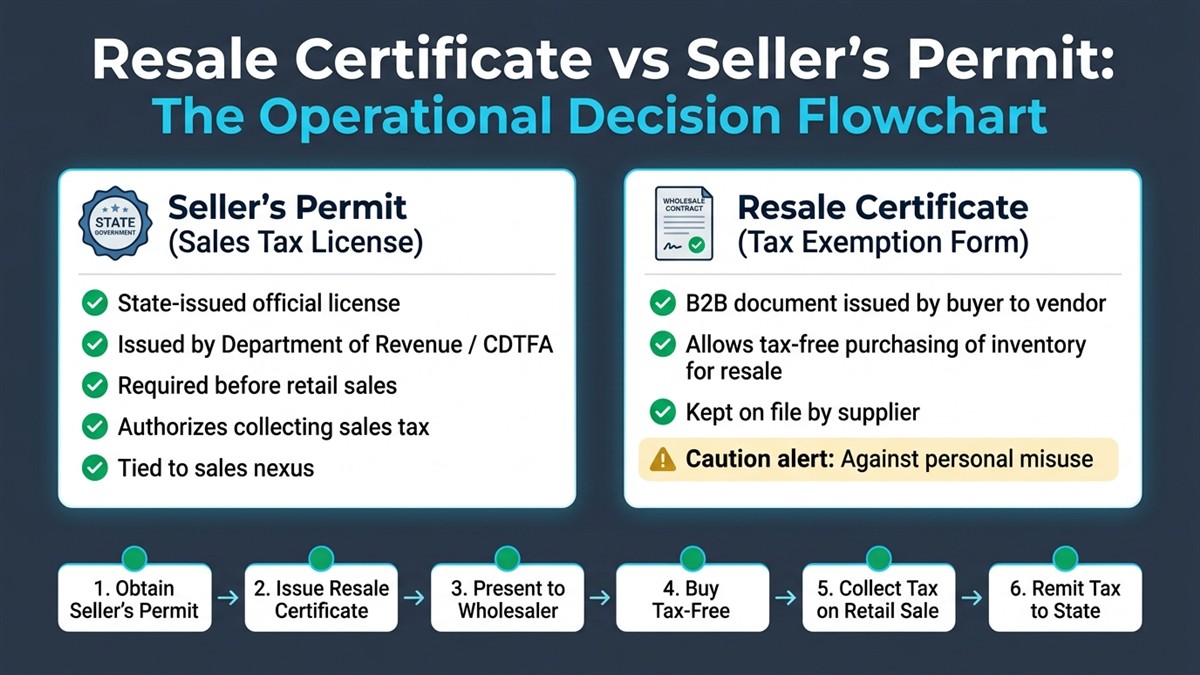
A seller’s permit goes by different terminology depending on state jurisdiction:
- California: Seller’s Permit (administered by the California Department of Tax and Fee Administration – CDTFA).
- Texas & Florida: Sales and Use Tax Permit / Certificate of Registration.
- New York: Certificate of Authority (mandatory posting in brick-and-mortar storefronts).
- Illinois: Certificate of Registration (issued by Illinois Department of Revenue – IDOR).
If you operate a physical retail shop, attend weekend trade markets, or exceed state economic nexus thresholds ($100,000 in gross sales or 200 separate transactions following the Supreme Court’s South Dakota v. Wayfair ruling), holding an active permit is mandatory. Furthermore, maintaining strict financial controls over collected tax liabilities is critical to avoid commingling funds; review our operational bookkeeping checklist for small business owners to track tax escrow accounts properly.
2. When You Need a Resale Certificate
You need a resale certificate only when purchasing items from manufacturers, wholesale liquidators, or suppliers that you intend to resell directly or integrate into a finished product for resale. It functions as a formal legal declaration that sales tax should not be collected at the wholesale level.
Common scenarios requiring a resale certificate include:
- Wholesale Retail Inventory: A boutique clothing retailer buying 500 dresses from a garment manufacturer to sell in their downtown store.
- Raw Manufacturing Materials: A custom furniture maker purchasing raw lumber and commercial hardware to construct dining tables sold to homeowners.
- E-Commerce Dropshipping: An online merchant providing an exemption certificate to their third-party fulfillment distributor so goods ship without retail tax.
Wholesale distributors do not evaluate your profitability; they collect resale certificates to protect themselves during state sales tax audits. If a wholesaler fails to keep a signed, valid certificate on file for a tax-exempt transaction, state auditors force the wholesaler to pay the uncollected sales tax out of pocket plus penalties. If your company manages extensive supplier transactions and short-term capital requirements, our financial guide on how to calculate working capital for small businesses ensures you balance inventory overhead effectively.
3. The Golden Rule of Resale Certificates: The End-Use Test
The single most frequent tax violation audited by state revenue agencies is using a resale certificate to purchase consumable supplies used in daily business operations. A resale certificate cannot be used to buy items your business consumes internally.
Examine these explicit compliance boundaries:
- Permitted (Tax-Exempt): Packaging boxes and bubble wrap that physically accompany the product to the end customer.
- Illegal (Taxable): Packing tape dispensers, office computers, printer paper, warehouse cleaning supplies, and showroom display shelves.
- Illegal (Severe Fraud): Personal consumer goods, home electronics, or personal vehicles purchased through wholesale business portals under a resale tax exemption.
If state auditors discover consumable supplies bought tax-free, they assess statutory use tax, retroactively charge the uncollected sales tax, enforce mandatory interest, and can levy a 50% to 100% intentional fraud civil penalty. For new founders currently structuring corporate accounts and trade credit, our step-by-step guide on how to get a Dun and Bradstreet number for an LLC for free establishes the foundational corporate identity needed for Tier-1 vendor credit lines.
4. Multi-State Resale Certificates: The MTC and SST Uniform Forms
If your business purchases wholesale merchandise from manufacturers located across multiple states, you do not need to register separate seller’s permits in all 50 states to buy inventory tax-free. You can utilize standardized multi-state exemption certificates.
Two primary uniform documents simplify interstate wholesale transactions:
- Multistate Tax Commission (MTC) Uniform Sales & Use Tax Certificate: Accepted by approximately 38 participating member states. Allows out-of-state buyers to input their home-state seller’s permit number to purchase inventory across state borders.
- Streamlined Sales Tax (SST) Certificate of Exemption: Standardized across 24 participating SST member states, streamlining e-commerce inventory procurement and digital tax exemptions.
- Home-State-Only Exceptions: Note that strict “drop-ship” states (including California, Florida, Massachusetts, and Hawaii) often refuse out-of-state resale certificates and demand a native state permit registration.
Protecting your cash flow while navigating supplier accounts and wholesale receivables requires disciplined invoice recovery; consult our blueprint on how to track unpaid invoices for small businesses to maintain clean cash cycles.
Frequently Asked Questions
Can I get a resale certificate without a seller’s permit?
No. A resale certificate requires you to list your active state seller’s permit or sales tax license number. Wholesalers verify this state tax ID with the Department of Revenue before approving tax-exempt wholesale accounts.
Does a seller’s permit expire?
In most states, seller’s permits remain active indefinitely as long as you file regular sales tax returns (monthly, quarterly, or annually). However, states like Texas, Pennsylvania, and Arizona require periodic license renewals every 1 to 5 years.
What is the penalty for using a resale certificate for personal purchases?
Using a resale certificate for personal items constitutes tax fraud. State penalties include revocation of your seller’s permit, payment of back taxes with mandatory interest, civil penalties of 10% to 50%, and potential misdemeanor or felony criminal charges.
Are resale certificates accepted across state lines?
Yes, most states accept the Multistate Tax Commission (MTC) Uniform Certificate or allow out-of-state sellers to provide their home-state permit number. However, states like California, Florida, and Hawaii require a native state seller’s permit for tax exemption.

