



A small business bookkeeping checklist is a systematic accounting protocol organized across daily, weekly, monthly, quarterly, and annual maintenance cadences to ensure 100% financial accuracy and tax compliance. Operating a business without scheduled bookkeeping reconciliations leads to untracked cash leakages, delayed customer invoicing, and severe IRS tax penalties. Establishing a disciplined routine transforms accounting from an exhausting year-end emergency into an automated operational asset.
Disciplined financial recordkeeping directly protects your daily liquidity and strengthens core working capital reserves. When accounts receivable float past maturity, understanding how billing delays impact short-term liquidity is vital, as outlined in our guide on how to calculate working capital for a small business. Furthermore, establishing rigorous invoice aging oversight prevents bad debt write-offs, which we detail in our blueprint on how to track unpaid invoices for a small business.
The Bookkeeping Golden Equation
Assets = Liabilities + Owner’s Equity
Every financial entry must balance perfectly across double-entry ledgers. Regular cadence reconciliations ensure your general ledger matches physical cleared bank records to the penny.
The 5-Tier Bookkeeping Cadence Framework
Attempting to manage all bookkeeping tasks at once overwhelms business owners and invites human error. Segmenting your responsibilities into five discrete time horizons guarantees complete accounting control:
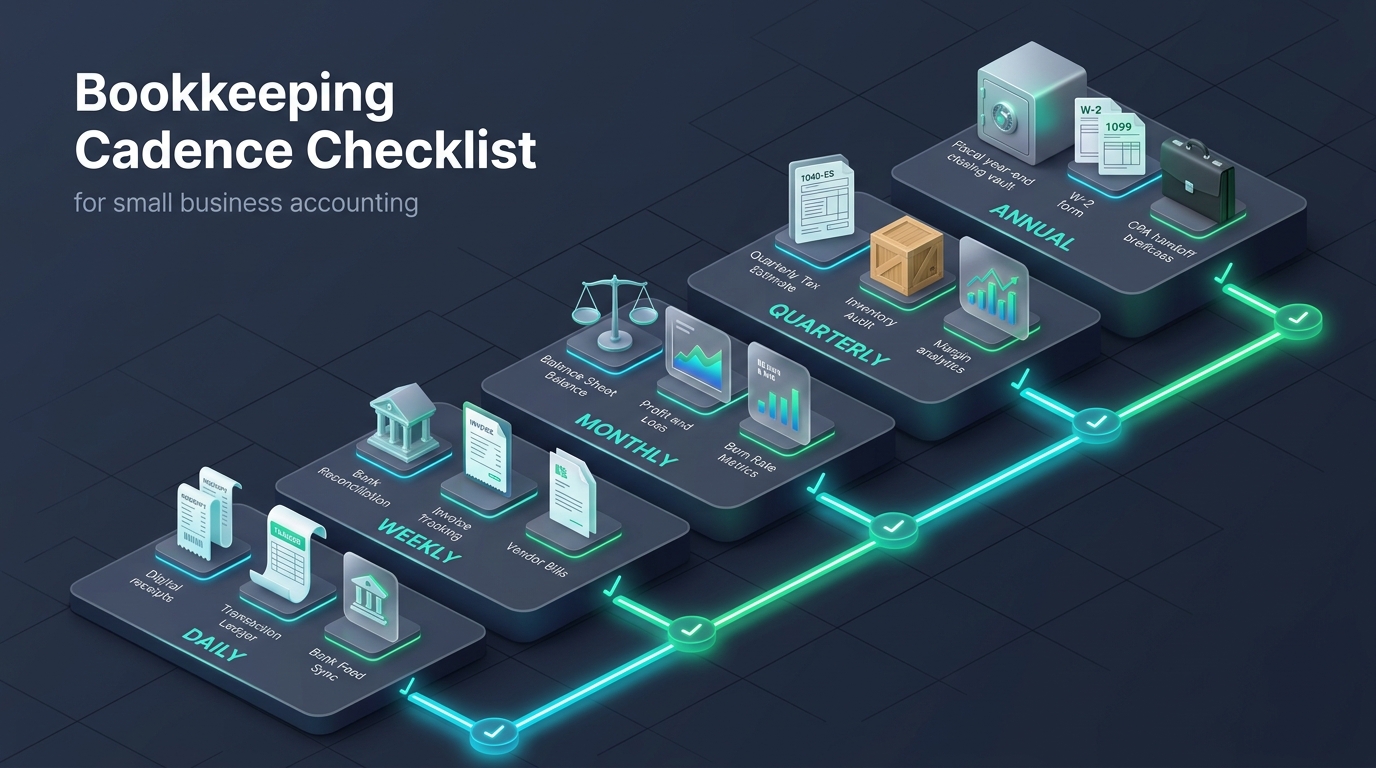
1. Daily Bookkeeping Checklist (5 to 10 Minutes)
Daily bookkeeping focuses on real-time transaction capture to eliminate month-end receipt backlogs. Complete these three rapid maintenance steps at the end of each business day:
- Review Bank and Credit Card Feeds: Open your cloud accounting software (QuickBooks Online, Xero, or FreshBooks) and categorize incoming and outgoing transaction feeds.
- Digitize Physical Point-of-Sale Receipts: Snap photos of paper receipts using mobile optical character recognition (OCR) apps and attach them to corresponding ledger debits.
- Record Daily Sales and Cash Drops: Reconcile point-of-sale (POS) merchant batches against physical cash drawers to detect discrepancies immediately.
2. Weekly Bookkeeping Checklist (30 to 45 Minutes)
Weekly bookkeeping governs cash velocity, accounts receivable aging, and vendor payment schedules. Schedule a recurring 45-minute calendar block every Friday afternoon:
- Invoice Completed Client Deliverables: Issue itemized invoices with clear payment terms and digital payment links within 24 hours of project milestones.
- Audit Accounts Receivable Aging: Review outstanding customer invoices. Dispatch automated reminders for claims approaching 15 days past due and escalate 30-day delinquent accounts.
- Review and Schedule Accounts Payable (A/P): Input vendor bills and schedule outbound disbursements to capture early payment discounts (e.g., 2/10 Net 30) while preserving cash buffers.
- Track Weekly Payroll and Contractor Hours: Log billable employee hours, verify overtime approvals, and fund dedicated payroll tax withholding accounts.
3. Monthly Bookkeeping Checklist (60 to 90 Minutes)
The monthly close reconciles sub-ledgers against third-party banking records and generates core executive financial statements. Execute this comprehensive audit within the first five business days of each month:
| Monthly Task | Operational Action | Compliance Benchmark |
|---|---|---|
| Bank Reconciliation | Reconcile operating, savings, merchant, and credit card accounts | Difference must equal \$0.00 against statements |
| Close Profit & Loss (P&L) | Compare actual revenues and operating expenses to budget | Identify variance deviations exceeding 5% |
| Balance Sheet Audit | Review assets, debt balances, and equity distribution accounts | Ensure assets equal liabilities plus equity |
| Inventory Reconciliation | Adjust book inventory values against physical cycle counts | Account for spoilage, shrinkage, and write-downs |
| Review Cash Burn & Runway | Divide total liquid reserves by average monthly net cash burn | Maintain a minimum 3 to 6 months operating buffer |
4. Quarterly Bookkeeping Checklist (2 to 3 Hours)
Quarterly bookkeeping centers on statutory federal tax compliance and macroeconomic performance evaluation. Complete these tasks prior to federal quarterly tax deadlines:
- Remit Quarterly Estimated Federal & State Taxes: Calculate net business taxable profit and file estimated income taxes using IRS Form 1040-ES or Form 1120-W.
- File State and Local Sales Tax Returns: Reconcile collected sales tax liabilities across all economic nexus jurisdictions and remit payments before state deadlines.
- Audit Form 941 Quarterly Payroll Returns: Verify employer federal tax withholdings against quarterly state unemployment insurance (SUI) filings.
- Conduct Executive KPI and Margin Reviews: Evaluate gross profit margins, customer acquisition costs, and departmental overhead to adjust quarterly operating budgets.
5. Annual Year-End Bookkeeping Checklist
The annual bookkeeping close prepares your corporate financial package for painless CPA tax preparation and corporate filing. Execute these strategic year-end steps before January 31st:
- Issue Form 1099-NEC and Form W-2: Transmit Form 1099-NEC to all independent contractors paid \$600 or more and deliver W-2 forms to employees by January 31st.
- Perform Complete Year-End Inventory Count: Conduct a comprehensive physical warehouse audit to establish beginning and ending Cost of Goods Sold (COGS).
- Review Bad Debt Write-Offs: Write down uncollectible customer accounts past 120 days under IRC Section 166 to reduce taxable business income.
- Reconcile Fixed Asset Depreciation Schedules: Calculate Section 179 and bonus depreciation deductions for qualifying capital equipment and machinery acquired during the fiscal year.
- Generate CPA Tax Package: Compile finalized Balance Sheets, Income Statements, General Ledgers, and 12-month bank reconciliation logs for your tax accountant.
Top 4 Bookkeeping Mistakes Small Businesses Make
Commingling business and personal finances remains the single most destructive bookkeeping error. Paying personal expenses from corporate accounts pierces the corporate veil, destroying LLC liability protections and complicating IRS audit defenses. Maintain completely isolated business checking and credit card accounts from day one.
Failing to reconcile bank accounts monthly allows hidden bank fees, merchant duplicate charges, and internal billing errors to compound unnoticed. A general ledger balance that does not tie out to an official bank statement is fundamentally inaccurate.
Relying on shoeboxes of physical paper receipts guarantees lost deductions during IRS audits. Standardize digital receipt capture protocols using cloud OCR systems to ensure documents remain legible and audit-proof under IRS Revenue Procedure 97-22.
Monthly Governance Checklist for Small Business Owners
Piyush Dwivedi’s Bookkeeping Governance Schedule
- Every Morning (9:00 AM): 5-minute review of prior day cleared bank feed transactions.
- Every Friday (4:00 PM): 30-minute review of unpaid customer invoices and approval of scheduled vendor bills.
- 1st of Every Month: Full bank and credit card statement reconciliation down to \$0.00 variance.
- 15th of Quarter-End (Apr, Jun, Sep, Jan): Finalize estimated quarterly tax calculations with CPA.
- December 15th: Schedule annual asset depreciation, contractor 1099 audits, and tax strategy reviews.
What should be on a small business bookkeeping checklist?
A complete small business bookkeeping checklist includes daily bank feed reviews, weekly invoice and bill processing, monthly bank reconciliations and P&L closes, quarterly estimated tax filings, and annual 1099/W-2 preparation and CPA tax package handoffs.
How often should a small business do bookkeeping?
A small business should perform bookkeeping tasks on a structured cadence: daily 5-minute transaction sweeps, weekly 30-minute invoice reviews, and monthly 90-minute formal reconciliations. Leaving bookkeeping to annual tax season guarantees costly errors.
What is the most important monthly bookkeeping task?
The most important monthly bookkeeping task is completing bank and credit card reconciliations. This process ensures that internal accounting ledgers match cleared third-party financial institution records down to zero variance.
Can a small business owner do their own bookkeeping?
Yes, small business owners can manage their own bookkeeping using modern cloud accounting platforms like QuickBooks Online or Xero, provided they follow a structured weekly checklist and partner with a certified CPA for quarterly tax planning and annual filings.
What documents does a CPA need from a small business at year-end?
A CPA requires a finalized Profit and Loss Statement, Balance Sheet, General Ledger, 12-month bank reconciliation reports, fixed asset purchase receipts, Form 1099/W-2 summaries, and ending inventory valuation logs.
-
What should be on a small business bookkeeping checklist?
A complete bookkeeping checklist organizes accounting duties across daily, weekly, monthly, quarterly, and annual intervals. Cadence scheduling prevents tax season backlogs and ensures continuous financial accuracy.
-
How often should a small business do bookkeeping?
Execute bookkeeping on a multi-tier cadence rather than waiting for year-end tax preparation. Spending 5 minutes daily on transaction feeds and 45 minutes weekly on invoicing preserves cash control.
-
What is the most important monthly bookkeeping task?
Performing full bank and credit card statement reconciliations is the single most vital task. Reconciling internal general ledgers against bank statements confirms that cash records match down to \$0.00 variance.
-
Can a small business owner do their own bookkeeping?
Yes, business owners can manage internal bookkeeping with modern cloud software like QuickBooks or Xero. Partnering with a licensed CPA for quarterly tax planning provides necessary regulatory oversight.
-
What documents does a CPA need from a small business at year-end?
CPAs require finalized P&L statements, balance sheets, bank reconciliations, 1099 summaries, and inventory logs. Delivering a verified, reconciled package accelerates filing and minimizes CPA hourly fees.

