



Tracking unpaid invoices requires establishing an automated Accounts Receivable (A/R) aging schedule that categorizes outstanding claims by payment delinquency intervals. Small business cash flow problems rarely originate from insufficient client demand; they stem from sluggish invoice conversion that traps liquid capital on customer balance sheets. Without an aggressive tracking and collections protocol, overdue receivables transform into uncollectible bad debt.
Allowing client invoices to float past maturity compromises working capital and forces business owners into expensive emergency debt financing. Managing your cash flow starts with understanding the mathematical relationship between outstanding receivables and day-to-day liquidity, which we break down comprehensively in our guide on how to calculate working capital for a small business.
Core Accounts Receivable Metric: Days Sales Outstanding (DSO)
DSO = (Total Accounts Receivable ÷ Total Credit Sales) × Number of Days in Period
A healthy small business DSO remains below 45 days. A DSO exceeding 60 days signals severe collection friction that demands immediate operational intervention.
The 5-Stage Unpaid Invoice Tracking and Recovery Workflow
Transforming overdue billing into cash demands a standardized, progressive escalation system rather than random email check-ins. Implement this 5-stage tracking and recovery framework to systematically accelerate invoice velocity:
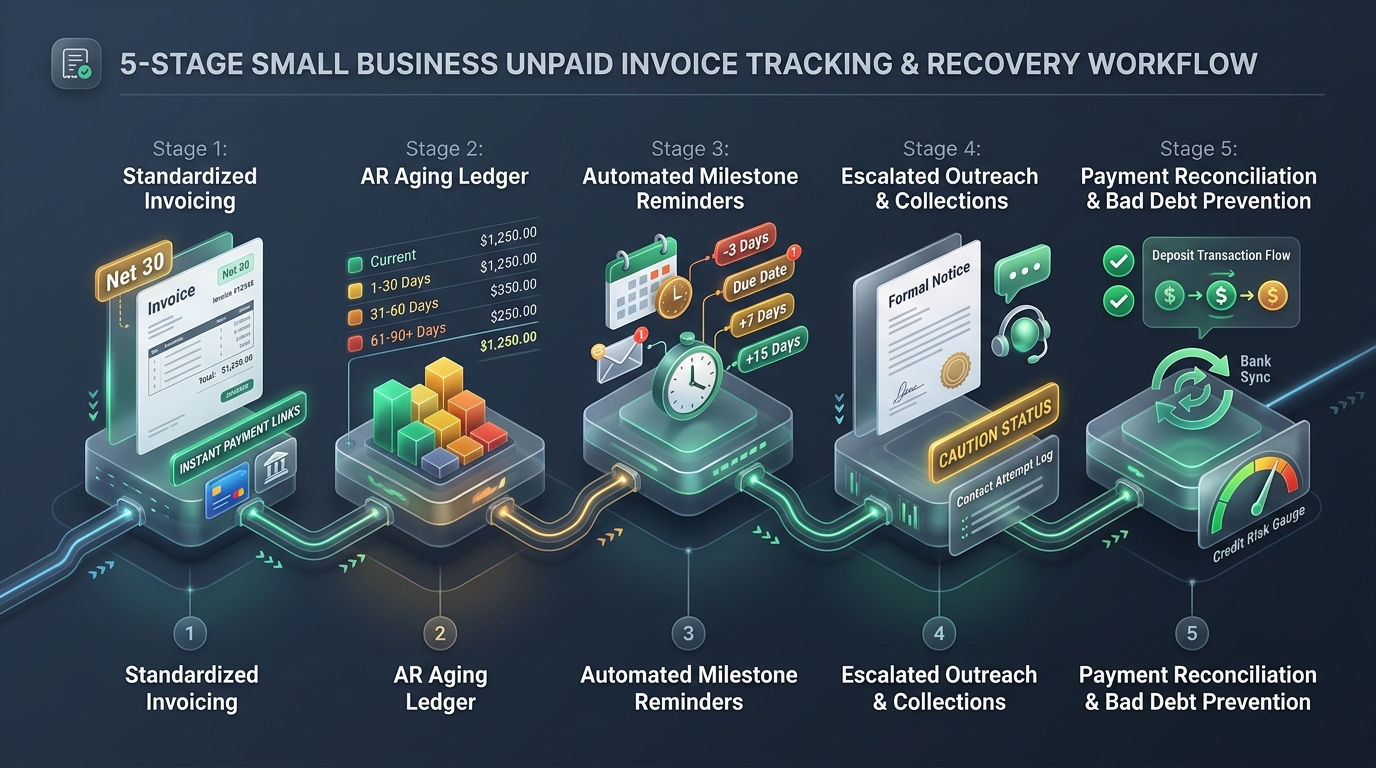
1. Issue Standardized Invoices with Explicit Payment Terms
Deliver polished, itemized invoices within 24 hours of project milestone completion or product delivery. Specify explicit numerical due dates rather than ambiguous terms like “payable upon receipt.” Integrate clickable digital payment methods (ACH transfer, instant corporate credit card, or SEPA payments) directly into the electronic invoice body to eliminate payment friction.
2. Maintain a Dynamic Accounts Receivable Aging Report
Segment all outstanding billing claims into four standardized aging buckets: 1–30 days, 31–60 days, 61–90 days, and 90+ days past due. Review this aging matrix weekly to monitor collection health and spot chronic late-payers. Track payment behavior by individual customer profile to identify clients whose Days Sales Outstanding consistently trends upward.
3. Automate Multi-Touch Milestone Reminders
Deploy automated billing notifications calibrated to crucial invoice lifecycle milestones. Schedule an informational notice 3 days before maturity, an polite reminder on the exact due date, and a formal past-due notification at 7 days past due. Cloud billing platforms execute these notifications automatically, removing emotional hesitation from financial collections.
4. Execute Structured Escalation Protocols
Initiate direct phone communications the moment an unpaid invoice enters the 31–60 day delinquency bucket. Direct conversations with accounts payable decision-makers resolve billing disputes, missing tax identifiers, or lost invoice documentation instantly. If an account surpasses 45 days past due, immediately freeze ongoing deliverables, pause retainer services, and issue a formal Notice of Intent to Enforce Payment Terms.
5. Enforce Late Fees, Factoring, or Legal Collections
Apply contractually stipulated late payment penalties (typically 1.5% per month or 18% per annum) to overdue balances. For stubborn debts crossing the 90-day threshold, determine whether to sell the claims to an invoice factoring firm for immediate 70% to 85% liquidity or transmit the claim to legal counsel for small claims adjudication.
Accounts Receivable Aging Schedule Matrix
| Aging Category | Default Risk Level | Operational Action Trigger | Primary Communication Channel |
|---|---|---|---|
| Current (0–30 Days) | Minimal (Less than 2%) | Send invoice + digital payment link + pre-due reminder | Automated accounting email / client portal |
| 1–30 Days Past Due | Low to Moderate (5%–10%) | Issue 1st and 2nd past-due reminders; verify receipt with AP | Personalized email from account lead |
| 31–60 Days Past Due | Moderate to High (15%–25%) | Direct phone call to CFO / AP Manager; apply 1.5% late fee | Direct telephone call + certified digital statement |
| 61–90 Days Past Due | Severe (30%–45%) | Immediately freeze all ongoing client work; issue formal demand | Formal demand letter via registered mail + executive call |
| 90+ Days Past Due | Critical (50%+ loss risk) | Write-down evaluation, invoice factoring, or small claims filing | Commercial collection agency or corporate attorney |
Best Practices to Eliminate Unpaid Invoices Before They Happen
Require upfront milestone deposits for all non-retainer client engagements. Structure customer agreements with a non-negotiable 33% to 50% mobilization deposit before commencing project work. Upfront deposits cover initial operational labor and establish buyer financial commitment from day one.
Incentivize early settlements by utilizing trade credit terms like “2/10 Net 30.” Offering clients a 2% discount if they settle invoices within 10 days accelerates your cash conversion cycle dramatically. Clients seeking to optimize their own accounts payable returns frequently jump at risk-free discounts.
Conduct formal credit evaluations before extending Net 30 or Net 60 trade terms to unfamiliar corporate entities. Check commercial credit scores through Dun & Bradstreet or Experian Business Credit. For entities with limited credit histories, mandate automated credit card authorization or weekly auto-debits via Stripe or GoCardless.
Legal Rights and Collections Regulations
The federal Fair Debt Collection Practices Act (FDCPA) regulates third-party collectors, but original business creditors must comply with state commercial collection statutes. Commercial disputes remain bound by contract law and the Uniform Commercial Code (UCC). Maintain an unbroken paper trail of signed master services agreements (MSAs), approved change orders, and verified timesheets to defend your claims in dispute arbitration.
When debt recovery stalls completely, writing off uncollectible accounts as bad debt provides tax deductions under Section 166 of the Internal Revenue Code. For accrual-basis taxpayers, bad debt deductions offset reported taxable revenue, softening the financial hit of uncollectible accounts.
Weekly Accounts Receivable Governance Checklist
Piyush Dwivedi’s Weekly Invoice Tracking Protocol
- Tuesday Morning Aging Review: Pull fresh Accounts Receivable Aging reports across all client billing sub-ledgers.
- Automated Reminder Audit: Verify that automated 3-day pre-due and 7-day past-due notifications dispatched without software errors.
- Escalated Call List: Contact the designated accounting contact for every client invoice crossing 30 days past due.
- Service Hold Authorization: Flag accounts crossing 45 days overdue and instruct project delivery managers to suspend active work.
- Late Fee Application: Post accrued late interest charges to non-responsive accounts as specified in contractual payment terms.
What is the most effective way to track unpaid invoices?
The most effective way is using automated cloud accounting software (QuickBooks Online, Xero, or FreshBooks) paired with a weekly Accounts Receivable aging report that categorizes invoices into 30, 60, and 90-day delinquency buckets.
When should a small business charge late fees on overdue invoices?
A small business should apply late fees (typically 1.5% per month or 18% annually) the day after an invoice passes its contractual due date, provided that late fee policies are explicitly stated in the signed client agreement.
What should you say when following up on an unpaid invoice?
Keep communications polite, professional, and clear. State the invoice number, total amount due, original due date, days past due, and provide a direct digital payment link. Ask if there are any billing questions or documentation needed to facilitate immediate payment.
When is an unpaid invoice considered uncollectible bad debt?
An unpaid invoice is typically classified as bad debt when it remains uncollected past 90 to 120 days and the debtor is unresponsive, insolvent, or entering bankruptcy. Accrual-basis businesses can write off verified bad debt as a tax deduction under IRC Section 166.
Should small businesses use an invoice factoring service?
Invoice factoring is beneficial when a small business faces immediate liquidity crunches and needs instant cash against slow-paying Net 60 or Net 90 creditworthy enterprise clients, despite paying a factoring fee of 1% to 5%.
-
What is the most effective way to track unpaid invoices?
Deploy automated cloud accounting software paired with a weekly Accounts Receivable aging report. Categorizing invoices into 30, 60, and 90-day aging buckets pinpoints liquidity risks before debts become uncollectible.
-
When should a small business charge late fees on overdue invoices?
Apply late fees the business day immediately following the contractual maturity date. Charging 1.5% per month (18% annually) enforces financial discipline, provided the policy is outlined in your signed client agreement.
-
What should you say when following up on an unpaid invoice?
State the invoice number, total sum due, original maturity date, and supply a one-click digital payment link. Inquire whether any administrative approvals or documentation are required to facilitate immediate remittance.
-
When is an unpaid invoice considered uncollectible bad debt?
An invoice is classified as bad debt when collections stall past 90 to 120 days and the customer is insolvent or unreachable. Businesses operating under accrual accounting can deduct confirmed bad debts under IRC Section 166.
-
Should small businesses use an invoice factoring service?
Invoice factoring provides rapid liquidity against slow Net 60/90 enterprise accounts when immediate payroll funding is needed. While factoring fees range from 1% to 5%, factoring transfers collection risks and frees trapped working capital.

