


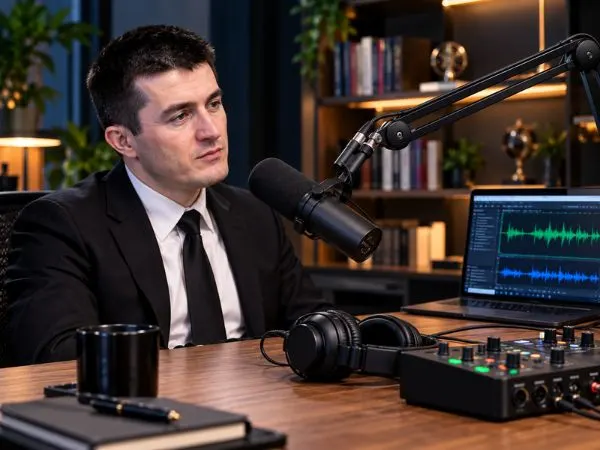
The Lex Fridman Podcast has become a gold standard for long-form, intimate conversations covering artificial intelligence, science, philosophy, and history. With interviews routinely stretching past three to four hours, one defining hallmark of the show is its audio clarity, warm vocal intimacy, and distraction-free visual aesthetic.
Rather than utilizing an overwhelming wall of broadcast rack gear or an overly complex commercial television set, Fridman relies on an efficient, battle-tested hardware chain.
The comprehensive Lex Fridman podcast mic and audio setup equipment list covers the core hardware, signal flow, camera choices, and audio configuration behind his high-profile studio and travel setups.
1. At a Glance: Complete Hardware Breakdown
| Category | Primary Equipment | Alternative / Field Unit | Estimated Price (USD) |
| Microphone | Shure SM7B / Shure SM7dB | Shure SM58 (Backup/Field) | $399 – $499 |
| Inline Preamp | Cloud Microphones Cloudlifter CL-1 | Built-in preamp (SM7dB version) | $149 |
| Audio Interface / Field Recorder | Sound Devices MixPre-6 II | Zoom F6 Multitrack Field Recorder | $799 – $1,050 |
| Boom Arm | RØDE PSA1 Professional Studio Boom | Yellowtec m!ka On-Air Arm | $99 – $120 |
| Headphones | Sony MDR-7506 Professional | Audio-Technica ATH-M50x | $99 – $149 |
| Studio Cameras | Sony FX3 / Sony A7S III (Multi-cam) | Sony FX6 (Master Wide) | $3,499 – $3,899 |
| Lenses | Sony FE 24-70mm f/2.8 GM II & 50mm f/1.4 | Sigma 24-70mm f/2.8 Art | $1,099 – $2,299 |
| Key Lighting | Aputure Light Storm 300d II / 600d | Aputure Light Dome II Softbox | $749 – $1,499 |
2. The Audio Chain: Microphones, Preamps & Signal Routing
[Shure SM7B Dynamic Mic]
          │
          ▼ (XLR Cable)
[Cloudlifter CL-1 Inline Preamp (+25dB Clean Gain)]
          │
          ▼ (XLR Cable)
[Sound Devices MixPre-6 II / Zoom F6 (32-Bit Float Recording)]
          │
          ▼ (SD Card Isolated WAV Stems + USB Audio Interface Out)
[DAW Editing & Sync (Post-Production Master)]
The Microphone: Shure SM7B & SM7dB
Dr. Fridman uses the Shure SM7B—the undisputed industry standard dynamic microphone for spoken word.
- Why it fits the show: Condenser microphones are overly sensitive and capture unwanted room reverberation, air conditioning rumble, and subtle desk taps. The SM7B is a low-output dynamic microphone with a tight cardioid polar pattern, meaning it rejects virtually all ambient noise that is not positioned directly in front of the capsule.
- Warm Proximity Effect: The SM7B naturally provides a thick, warm low-end boost when speaking within 2 to 3 inches of the capsule, producing that signature calm, radio-broadcast vocal tone.
The Gain Problem: Cloudlifter CL-1
The standard Shure SM7B is notoriously “gain-hungry,” requiring around +60 dB of clean amplification to reach healthy digital recording levels (-12 dB to -18 dB LUFS).
- When connected to budget audio interfaces, cranking the gain knob past 85% introduces audible background hiss and circuit noise.
- Fridman solves this by placing a Cloud Microphones Cloudlifter CL-1 inline between the microphone and the interface. The Cloudlifter runs on phantom power ($+48\text{V}$) to provide +25 dB of ultra-clean, transparent gain before the audio reaches the recorder’s preamps, guaranteeing a silent noise floor.
The Field Recorder / Interface: Sound Devices MixPre Series
Rather than recording directly into a computer laptop that could crash or introduce latency during four-hour discussions, Fridman relies on dedicated hardware recorders:
- Sound Devices MixPre-6 II: Featuring discrete Kashmir microphone preamplifiers with an exceptionally low noise floor (-130 dBV EIN).
- Zoom F6 (Mobile / Travel Rig): Employs 32-bit float point recording technology, meaning audio signals cannot digitally clip or distort even if a guest suddenly laughs or raises their voice unexpectedly.
3. The Visual Setup: Cameras, Lenses & Framing
The Lex Fridman Podcast uses a three-camera setup designed to capture both participants intimately while maintaining a cinematic, shallow depth of field:
                  [Camera 1: Wide Angle Angle - Both Subjects]
                                       │
           ┌───────────────────────────┴───────────────────────────┐
           ▼                                                       ▼
[Camera 2: Tight Close-Up on Lex]                     [Camera 3: Tight Close-Up on Guest]
- Cameras: Sony Cinema Line full-frame mirrorless bodies (Sony FX3 and Sony A7S III). Full-frame sensors ensure exceptional low-light capability and organic skin tones without digital sharpness artifacts.
- Lenses: Fast zoom and prime glass, primarily the Sony FE 24-70mm f/2.8 GM II and 50mm / 85mm prime lenses wide open at $f/2.0$ to $f/2.8$. This creates the creamy blurred background (bokeh) that isolates the subject from the dark studio walls.
- Color Profile: Shot in neutral Picture Profiles (or Sony S-Log3 / S-Cinetone) to retain maximum dynamic range in the dark suits, shadows, and subtle skin highlights.
4. Studio Lighting: The Dark, Focused Aesthetic
The visual tone of Lex Fridman’s studio is distinct: pitch-black surroundings with soft, directional light sculpting the subjects.
- Key Light: A large, diffused source—typically an Aputure LS 300d II or 600d shooting through an Aputure Light Dome II (35-inch softbox) with an eggcrate grid. The grid prevents light from spilling onto the black walls behind the desk.
- Positioning: High and 45 degrees to the side of the subject, creating classic Rembrandt-style lighting with a subtle catchlight in the eyes.
- Hair/Rim Light: Subtle overhead warm LED strip or miniature spotlight to trace the subject’s shoulders, separating them from the dark acoustic backdrop.
5. How to Replicate the Lex Fridman Setup on a Budget
Recreating this studio does not require thousands of dollars. You can achieve an almost identical audio and video look using this tiered alternative setup:
| Level | Microphone Setup | Interface / Preamp | Camera & Lens | Total Cost |
| Pro (Exact Lex Rig) | Shure SM7B + Cloudlifter CL-1 | Sound Devices MixPre-6 II | Sony FX3 + 24-70mm f/2.8 GM | ~$5,500+ |
| Mid-Tier (Best Value) | Shure SM7dB (Built-in Preamp) | Focusrite Scarlett 2i2 (4th Gen) | Sony ZV-E10 II + Sigma 30mm f/1.4 | ~$1,400 |
| Budget Friendly | RØDE PodMic or Audio-Technica ATR2100x | Elgato Wave XLR / Behringer UMC202HD | Sony ZV-1 or Lumix G7 | ~$500 |
also read : – Andrew Huberman Daily Routine Schedule: Hour-by-Hour Time Breakdown
Frequently Asked Questions (FAQ)
What microphone does Lex Fridman use?
Lex Fridman uses the Shure SM7B dynamic microphone (and the updated Shure SM7dB model) for both himself and his guests, mounted on RØDE PSA1 boom arms.
Does Lex Fridman use a Cloudlifter?
Yes, in his classic Shure SM7B setup, he utilizes a Cloud Microphones Cloudlifter CL-1 inline preamp to boost the microphone’s gain by +25 dB while keeping background hiss completely silent.
What boom arm is on the Lex Fridman Podcast desk?
The studio microphones are mounted on the RØDE PSA1 Professional Studio Boom Arm, known for its silent internal spring mechanics and wide positioning flexibility.
Why does the Lex Fridman studio have a black background?
The black, non-reflective studio background eliminates visual distractions, maximizes viewer focus on the dialogue, and prevents light bounce, creating a high-contrast cinematic atmosphere.

