


Many retail investors notice an unexpected deduction on their contract notes or ledger statements when selling delivery shares. Even on discount brokers advertising “Zero Brokerage on Equity Delivery,” a flat debit of ₹13.50 to ₹20 plus GST appears on the account balance.
This fee is not brokerage—it is a Depository Participant (DP) charge.
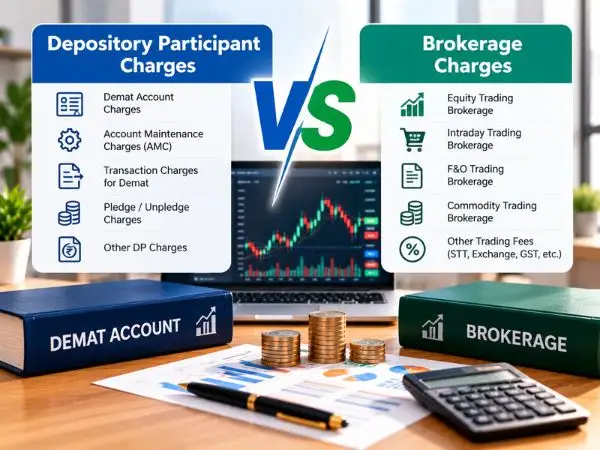
Understanding the depository participant charges vs brokerage charges difference clarifies how stock trading deductions work, why DP charges cannot be avoided on equity delivery sales, and how hidden transaction levies affect your net investment returns.
1. Quick Summary: DP Charges vs. Brokerage Charges
| Feature | Depository Participant (DP) Charges | Brokerage Charges |
| Charged By | The Depository (CDSL / NSDL) + Depository Participant (Broker) | The Stockbroker exclusively (Zerodha, Angel One, Groww, etc.) |
| Applicable On | Selling equity delivery shares only | Buying and Selling (Intraday, F&O, Delivery where applicable) |
| Calculation Basis | Flat fee per scrip (company) per day, regardless of quantity | Percentage of trade value or flat fee per executed order |
| Visible on Contract Note? | No (Directly debited from your trading ledger/funds balance) | Yes (Listed explicitly on the daily digital contract note) |
| Intraday Applicability | Zero / Nil (Shares do not leave the depository demat pool) | Charged on both buy and sell legs |
| Regulatory Framework | Governed under Depositories Act & SEBI guidelines | Governed by individual broker-client fee agreements |
2. What Are Brokerage Charges?
Brokerage is the fee charged directly by your stockbroker for executing trade orders on recognized exchanges like the NSE and BSE.
Investor ──> Places Buy/Sell Order on App ──> Broker Routes Order to Exchange ──> Brokerage Charged
Types of Brokerage Models:
- Discount Brokers (Flat Fee): Charge a fixed amount (typically ₹20 per executed order or 0.05%, whichever is lower) on Intraday and F&O, while frequently offering ₹0 brokerage on long-term delivery trades.
- Full-Service Brokers (Percentage-Based): Charge between 0.10% and 0.50% of total turnover, bundling equity advisory, research reports, and relationship management.
Because brokerage is an operational transaction fee, it appears immediately on your daily Contract Note alongside exchange turnover fees and Securities Transaction Tax (STT).
3. What Are Depository Participant (DP) Charges?
In modern electronic investing, your stockbroker is merely a facilitator, while your actual shares reside securely inside a national central depository:
- CDSL (Central Depository Services Limited)
- NSDL (National Securities Depository Limited)
A Depository Participant (DP) is an intermediary (such as your broker or bank) registered with CDSL or NSDL to maintain your electronic holdings.
Whenever you sell shares held in your demat account, the depository must electronically debit those shares from your account and transfer them to the clearing corporation. The depository levies a maintenance fee for this ledger debit:
$$\text{Total DP Charge} = \text{Depository Fee (CDSL/NSDL Share)} + \text{Broker’s Internal DP Surcharge} + 18\% \text{ GST}$$
Why DP Charges Confuse Investors
- Not Shown on the Contract Note: DP charges are levied at the depository level, so they do not appear on your exchange-generated contract note. They appear as a direct debit on your broker’s ledger statement at the end of the trading day.
- Quantity Does Not Matter: Whether you sell 1 share or 10,000 shares of a company, the DP charge remains identical.
also read : – How to Calculate and Reduce PayPal International Fees Legally: Complete Merchant & Freelancer Guide
4. The Per Scrip Rule: How DP Charges Are Calculated
DP charges are calculated per company (scrip), per trading day, not per individual trade or transaction tranche.
Scenario A: You sell 5 shares of Tata Motors at 10:00 AM, and 10 shares of Tata Motors at 2:30 PM.
Result: Charged DP fee ONCE (1 scrip on 1 day).

Scenario B: You sell 1 share of Tata Motors and 1 share of Reliance on the same day.
Result: Charged DP fee TWICE (2 separate scrips).
Example Breakdown Across Popular Discount Brokers:
| Broker | CDSL/NSDL Share | Broker Share | Total Base Fee | Total After 18% GST |
| Zerodha | ₹5.50 | ₹8.00 | ₹13.50 | ₹15.93 |
| Groww | ₹3.50 | ₹10.00 | ₹13.50 | ₹15.93 |
| Angel One | ₹3.50 | ₹16.50 | ₹20.00 | ₹23.60 |
| Upstox | ₹3.50 | ₹15.00 | ₹18.50 | ₹21.83 |
5. Complete Regulatory Cost Breakdown on Stock Trades
Beyond brokerage and DP charges, statutory government levies apply to Indian equity trades:
Total Trading Costs
  ├── 1. Brokerage (Broker commission)
  ├── 2. DP Charges (Debited on delivery sales only)
  ├── 3. STT (Securities Transaction Tax - Central Government)
  ├── 4. Exchange Transaction Charges (NSE/BSE operational fees)
  ├── 5. SEBI Turnover Fee (Market regulatory fee)
  ├── 6. Stamp Duty (State revenue stamp levied on BUY trades)
  └── 7. GST (18% on Brokerage + Exchange Charges + DP Charges)
- STT (Securities Transaction Tax): 0.1% on both buy and sell legs for equity delivery.
- Stamp Duty: Levied only on delivery buy orders (0.015%).
- GST (Goods and Services Tax): A standard 18% applied to brokerage commissions, exchange charges, and DP charges (never applied directly to the share price or STT).
6. Practical Tips to Minimize DP Charges
- Avoid Selling in Fractional Lots Across Different Days: If you plan to sell 100 shares of an enterprise, sell them all on the same trading day rather than splitting 20 shares over 5 separate days. Selling over 5 days multiplies the DP charge by 5.
- Beware of Micro-Quantity Exits: Selling a single leftover bonus share worth ₹30 will still trigger a ~₹16 to ₹24 DP charge, wiping out more than half of the asset value. Wait to bundle micro-holdings.
- Understand Intraday and BTST Dynamics:
- Intraday Trades: No DP charge applies because shares never leave the exchange pool account to settle into your demat.
- BTST (Buy Today, Sell Tomorrow): If shares have not formally settled into your demat account prior to sale (T+1 cycle), some brokers do not levy DP charges, though regulatory settlement rules can vary.
Frequently Asked Questions (FAQ)
Are DP charges applicable when buying shares?
No. DP charges apply exclusively when shares are debited (sold) from your demat account. Buying delivery shares involves crediting your account, which carries zero DP charges.
Why does my contract note say ₹0 brokerage, but my ledger has deductions?
Zero-brokerage discount models waive the broker’s execution fee for delivery orders. However, regulatory taxes (STT, stamp duty, exchange turnover fees) and depository debit charges (DP fees) are mandatory third-party levies that brokers must collect and pass to the government and depositories.
Do mutual funds attract DP charges?
If you hold mutual funds in demat form through your brokerage account, redeeming them triggers a nominal depository debit charge. If you hold mutual funds in Statement of Account (SoA) non-demat form (via platforms like MFCentral or directly with AMCs), redemption carries zero DP charges.
Can an investor avoid DP charges completely?
DP charges are mandated whenever physical or demat shares are transferred out of a depository account. They cannot be eliminated for delivery sales. You can, however, minimize them by consolidating sales of the same company into single-day orders.

