


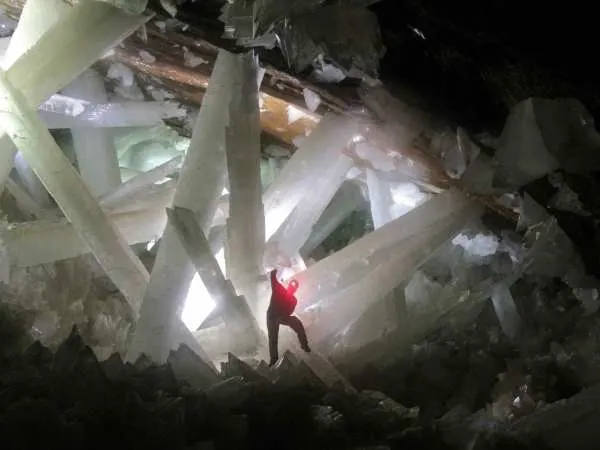
The mexico crystal cave sounds unreal the first time you hear about it. A cave filled with crystals taller than houses. Air so hot that people collapse in minutes. Walls made of clear white stone that looks frozen in time. It feels like science fiction. It is not.
Deep below the desert of northern Mexico sits one of the most extreme natural places ever found by humans. Scientists call it the Cave of the Crystals. Locals know it as part of the Naica mine. It is the largest crystal cave in the world, and no place like it exists anywhere else.
This story is not about beauty alone. It is about heat, pressure, time, danger, and chance. It explains where is Naica crystal cave located, who discovered the giant crystal cave in Mexico, crystal cave Mexico temperature, how was the Cave of Crystals formed, and why humans cannot safely stay inside it.
also read : – Leopard v Jaguar: Strength, Danger, Spots, and Why People Keep Mixing Them Up
Where Is Naica Crystal Cave Located
The cave sits near the small town of Naica in Chihuahua, Mexico. It lies about 300 meters underground inside an active mining complex. The official name is the Cave of the Crystals, located within the Naica Mine.
Naica Cave is not a tourist cave. It is not open to visitors. Access requires special permission, safety teams, and scientific purpose.
Above ground, the area looks quiet and dry. Below ground, conditions turn extreme.
Who Discovered the Giant Crystal Cave in Mexico
The discovery happened in the year 2000. Two miners were drilling a new tunnel inside the Naica mine. Water drained from a hidden chamber. The drill broke through a wall.
Behind it, they saw something no one expected.
Giant white crystals filled the space from floor to ceiling. Some stretched more than 11 meters long. Others were thicker than tree trunks. The miners stopped working and alerted supervisors.
Scientists arrived soon after. Word spread fast.
First Reactions to the Discovery
At first, people thought the crystals might be fragile or short-lived. That assumption proved wrong. These crystals had grown slowly for hundreds of thousands of years. They were stable. Massive. Untouched.
The cave remained sealed for most of its history. Humans arrived at the very end of a long geological process.
also read : – Lemmings Rodent: The Truth About Their Lives, Myths, Survival, and Strange Reputation
Crystal Cave Mexico Temperature: Why It Is So Dangerous
The crystal cave Mexico temperature is the main reason almost no one can enter.
Inside the cave:
- Air temperature reaches around 58°C
- Humidity stays near 100 percent
- Sweat cannot evaporate
- The human body overheats fast
Without protection, a healthy adult can lose consciousness in 5 to 10 minutes. Death follows soon after.
This heat comes from geothermal activity deep underground. Warm water once filled the chamber. That heat never left.
Why Humidity Makes It Worse
High humidity blocks the body’s cooling system. Sweat drips but does not cool. Breathing becomes heavy. Heart rate spikes.
Scientists must wear cooling suits with ice packs and oxygen. Even then, time inside stays limited to about 20 minutes.
This is one of the most hostile natural environments on Earth.
Largest Crystal Cave in the World
The Cave of the Crystals holds the title of largest crystal cave in the world for several reasons.
- Crystals reach lengths over 11 meters
- Individual crystals weigh up to 55 tons
- Crystal purity reaches extreme levels
- Chamber size supports massive growth
No other cave combines size, clarity, and scale like this one.
What Type of Crystals Are Inside
The crystals are made of selenite, a form of gypsum. Selenite forms in calm, stable conditions with mineral-rich water.
These crystals are not decorative gemstones. They are geological records. Each one reflects slow growth over immense time.
Some crystals grew at a rate of about one centimeter every hundred years.
also read : – WYD Meaning, What It Really Signals in Chat, and How People Usually Reply
How Was the Cave of Crystals Formed
The question how was the Cave of Crystals formed sits at the heart of this story.
Millions of years ago, magma rose beneath the region. That heat warmed underground water rich in calcium sulfate. The water filled the cave completely.
Temperature stayed stable for a very long time. That stability mattered more than anything else.
Crystals only grow large when conditions remain calm and unchanged. No shaking. No cooling. No sudden pressure changes.
Nature held the perfect balance.
Why These Crystals Grew So Large
Most crystals stop growing when conditions shift. In Naica, conditions stayed ideal for hundreds of thousands of years.
The water stayed warm. The chemistry stayed steady. Crystals grew without interruption.
That level of stability almost never happens.
What Happened When the Water Drained
Mining activity pumped groundwater out of the region. That water loss exposed the cave to air for the first time.
Crystals emerged from their liquid environment. Growth stopped. Preservation began.
Exposure also introduced new risks.
Why the Cave Cannot Stay Open
Once exposed, crystals face threats:
- Temperature changes
- Microorganisms
- Human contact
- Air movement
Even breathing near the crystals introduces bacteria. Over time, that damage adds up.
To protect the cave, access stays limited.
also read : – How Many Quarters Are in Ice Hockey?
Why Tourists Cannot Visit the Cave
People often ask why the cave is not open for tourism. The reasons stay clear.
- Extreme heat risks life
- High humidity causes collapse
- Crystals suffer damage
- Infrastructure would destroy the site
No safe tourist setup exists without ruining the cave.
Scientific Studies Inside the Cave
Scientists studied:
- Crystal growth rates
- Mineral chemistry
- Microbial life trapped inside crystals
Some microbes survived sealed inside crystals for tens of thousands of years. That discovery raised interest in astrobiology and extreme life studies.
The cave acts like a natural laboratory.
What Makes Naica Unique Compared to Other Crystal Caves
Other crystal caves exist. None match Naica.
Differences include:
- Crystal size
- Environmental stability
- Temperature extremes
- Depth
Naica represents an extreme end of geological possibility.
The Role of the Naica Mine
The cave exists inside an active mine. Mining exposed it. Mining also threatens it.
Once mining operations stop, groundwater may rise again. That could flood the cave and protect the crystals naturally.
Some scientists see flooding as the best long-term protection.
also read : – How to Find Someone’s Address Legally and Ethically
Can the Cave Be Preserved Forever
Preservation remains uncertain. Human exposure causes damage. Leaving it sealed reduces research access.
Flooding may restore the original environment. That choice involves trade-offs.
No perfect solution exists.
Why Photos of the Cave Look Unreal
Photos exaggerate scale due to perspective. Wide-angle lenses stretch crystal size.
Even without exaggeration, the cave looks unreal. Massive translucent beams reflect light like frozen lightning.
It feels more like architecture than geology.
Cultural Impact of the Mexico Crystal Cave
The cave inspired:
- Documentaries
- Science articles
- Art installations
- Public fascination
It became a symbol of nature’s extremes.
People often compare it to science fiction worlds.
Why the Cave Changes How We Think About Time
Human structures last centuries at best. These crystals took hundreds of thousands of years to form.
That contrast shifts perspective. Nature works slowly. When conditions align, results dwarf human effort.
Risks Faced by Scientists
Even with cooling suits, risks remain:
- Heat exhaustion
- Equipment failure
- Limited escape time
Research teams train carefully. Every visit follows strict timing.
Mistakes carry heavy consequences.
What Happens If the Mine Closes
If pumping stops, water may refill the cave. That would submerge the crystals again.
Some experts support this outcome. Submersion preserves crystals better than air exposure.
The cave may return to silence.
Why the Cave Feels So Fascinating
The fascination comes from extremes:
- Extreme size
- Extreme heat
- Extreme rarity
Places like this remind people that Earth still holds secrets beyond daily experience.
also read : – What Does OMB Mean? Understanding Its Different Uses Online and in Texting
Common Myths About the Cave
Some myths include:
- Crystals formed instantly
- The cave is alien-made
- Anyone can visit
None are true. Science explains the cave fully without fantasy.
FAQs
Where is Naica crystal cave located
It sits underground near Naica, Chihuahua, Mexico.
Who discovered the giant crystal cave in Mexico
Miners discovered it in the year 2000 during drilling.
What is the crystal cave Mexico temperature
Around 58°C with nearly full humidity.
How was the Cave of Crystals formed
Warm mineral-rich water stayed stable for hundreds of thousands of years.
Is it the largest crystal cave in the world
Yes, based on crystal size and scale.
Final Words
The mexico crystal cave is not just beautiful. It is extreme, fragile, and rare beyond comparison. Humans arrived at the very end of a long geological story. We saw it briefly. We studied it carefully. We learned from it. Whether it stays exposed or returns to water, the Cave of the Crystals stands as proof that Earth can still surprise us in ways that feel almost impossible.

